Inside Hoomanely’s Tech Encyclopedia: How Technology Builds Our Products
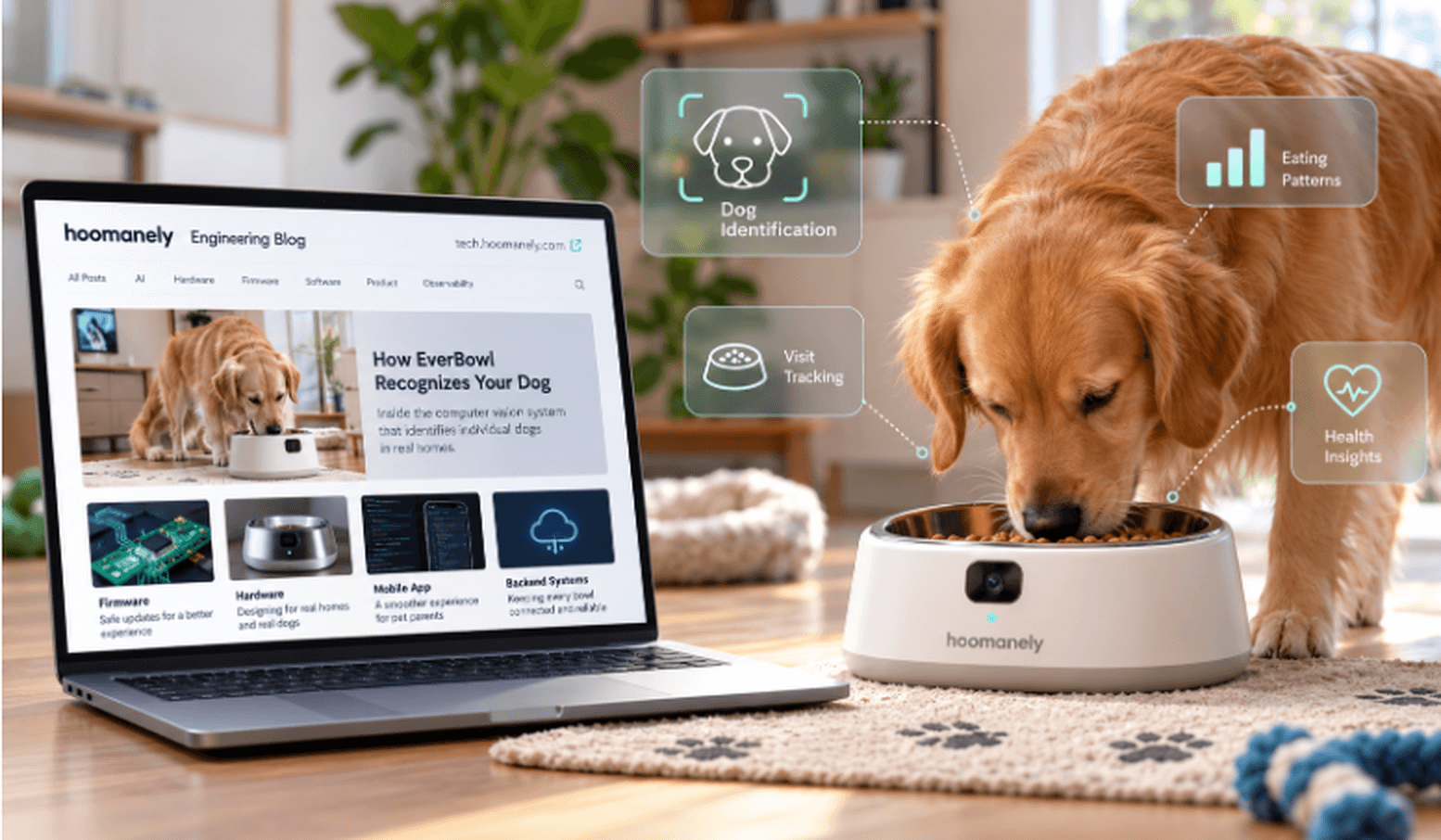
Hoomanely runs a second site, tech.hoomanely.com, where the engineers who build EverBowl™ write about how it works: the camera that recognizes which dog is at the bowl, the sensors that notice a visit, the software that keeps every bowl updated safely, and the app that holds the record. As of October 2026 it carries 470 posts, written by the people who did the work, with the numbers from their own tests and the mistakes they made on the way.
Think of it as Hoomanely’s tech encyclopedia: the reference for how our products are built, written by the people who build them. This post explains why it exists, what it covers, and where to start if you want to understand what sits under your dog’s bowl.
The short version
- tech.hoomanely.com is Hoomanely’s engineering blog: first-person accounts from the engineers who build EverBowl, not marketing copy.
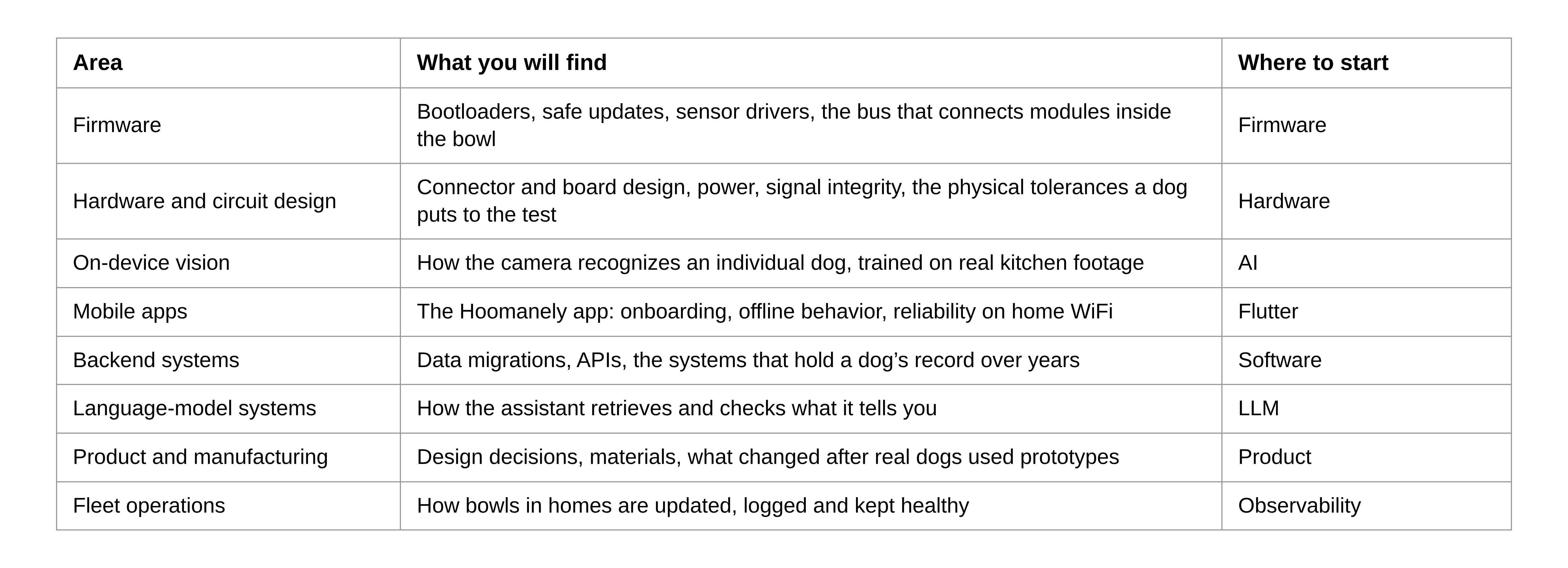
- It covers eight areas: firmware, hardware and circuit design, on-device vision, mobile apps, backend systems, language-model systems, product and manufacturing, and fleet operations.
- Every post states what was measured, what failed and what changed, which is the standard we hold ourselves to when we say EverBowl learns how a dog eats and drinks.
- Start with the five posts listed below; they cover the parts of EverBowl a pet parent is most likely to wonder about.
Why we publish our engineering notes
A product that watches your dog eat every day asks for trust. We think the way to earn it is to show the work: how the recognition model was trained, how often it is right, what happens when a firmware update fails in someone’s kitchen, and how the data from a bowl is moved without losing a row.
That is why the engineering blog reads differently from this one. Posts there are written by the firmware, vision, mobile and backend engineers themselves. They include the test counts, the thresholds, the oscilloscope traces and the dead ends. When a result was 67 percent rather than 95 percent, the post says 67 percent and explains the failure cases. We would rather a reader know exactly where the system stands than take a smoother number on faith.
What the blog covers
The posts fall into eight categories, each with its own page on the engineering site.
Five posts to start with
1. Dog identification by facial landmarks: real-world results
In a home with two or more dogs, a record is useless unless every visit is attributed to the right dog. This post reports what happened when the recognition system ran on 149 real frames from four days of home footage: 100 produced a match and 94 of those were the right dog, with every failure case listed. The follow-up, fine-tuning at enrollment time, shows how adding a new dog from a handful of phone photos went from 14.3 percent to 72.7 percent precision.
2. What dog behavior taught us about mechanical tolerances
The mechanical team’s account of watching real dogs lean, paw and nudge the bowl, and how a clearance that was correct on the drawing became a contact point in a kitchen. It explains why the most useful tolerance was never the tightest one.
3. Reducing false detections by training on bad indoor data
Clean training images produced a model that saw eyes in fur and noses on bowls. This post explains why the team deliberately trained on blurry, dark and partial frames from real kitchens, and what that did to accuracy.
4. Updates that cannot brick a device: how a bowl is updated safely
Every EverBowl receives software updates in the home. Updates that cannot brick a device: A/B OTA and canary, stage, fleet: shipping an OS to live homes describe how an update is written to a spare slot, checked on first boot, and rolled out to a few homes before all of them.
5. Local Bluetooth, global WiFi: the first minute in your kitchen
Onboarding an EverBowl walks through how the app finds the bowl over Bluetooth, hands it your WiFi details, and stays with it until it is online. The team spends a disproportionate share of its effort on that minute because it is the only moment you are actively involved.
Who writes it
Every post on the engineering blog carries the name of the engineer who did the work and links to their author page, where you can read everything else they have written. The team spans firmware, hardware, computer vision, mobile, backend and product engineering, and the About page introduces them. There is no content team in between; if a post describes a bug, the person who fixed it wrote it.
How this connects to EverBowl™
EverBowl™ learns how a dog eats and drinks over weeks and months, and recognizes when that pattern drifts from the dog’s own baseline. Everything on the engineering blog is in service of making that record trustworthy: the recognition work so each visit belongs to the right dog, the sensing and calibration work so every visit is noticed, the update and fleet work so the bowl behaves the same on day 400 as on day 1, and the backend work so years of record are never lost in a migration. EverBowl does not diagnose anything; it will not tell you why a change happened. The value is the record: when a change started and how it has moved, in enough detail for your vet to act on, instead of your best recollection. Every meal and every sip becomes a thorough health check.
Conclusion
If you want to know how EverBowl works, the engineers have already written it down, with the numbers. Start with the five posts above, follow a category that interests you, and read the author pages to see who is behind each decision. The engineering blog is at tech.hoomanely.com, and it is updated as the work happens.
FAQs
What is tech.hoomanely.com?
Hoomanely’s engineering blog. The engineers who build EverBowl publish first-person accounts of how the product works, with their own test results, failures and design decisions. As of October 2026 it holds 470 posts across eight categories.
Is the engineering blog written for pet parents or for engineers?
For engineers first, which is why the posts carry code, measurements and trade-offs. Pet parents who want to understand what sits under their dog’s bowl will find the five starting posts above readable without a technical background.
Does the engineering blog explain how EverBowl identifies my dog?
Yes. The vision series covers the full pipeline, the real-world results on home footage, how a new dog is added from phone photos, and the cases where recognition fails and the system returns nothing rather than a guess.
Can I see who wrote each post?
Yes. Every post carries the author’s name linked to a page listing their other posts, and the About page introduces the team.
Does the engineering blog publish failures as well as successes?
Yes. Posts state what was measured, what did not work and what changed as a result. A detection rate of 67 percent is reported as 67 percent, with the failure cases broken down.
Does reading the engineering blog help me use EverBowl?
Indirectly, yes. It explains why onboarding works the way it does, why updates arrive in stages, and why a visit is sometimes recorded without an identified dog. The app remains the place to read your own dog’s record.