How to Tell If Your Dog Is in Pain: Signs, Symptoms & Behavioral Changes

How do I know if my dog is in pain? Usually from a change in their normal behavior, movement, posture, appetite, sleep, or response to touch, not from crying.
Collapse, severe breathing difficulty, uncontrolled bleeding, major trauma, or an inability to stand needs emergency veterinary care rather than home observation.
Pain is not always dramatic. Dogs may still eat, wag their tail, or greet you while hurting. Chronic pain is particularly easy to miss, and osteoarthritis is common. AAHA's pain-management guidance cites reported canine osteoarthritis prevalence approaching 40%, which is one reason small mobility and behavior changes deserve attention.
The Short Version
- Look for change from your dog's individual baseline. Cornell lists altered mobility, posture, activity, social behavior, appetite, sleep, grooming, and reactions to touch among signs that may accompany pain.
- A limp is not the only pain sign. A hunched posture, trembling, panting at rest, difficulty settling, reluctance to climb stairs, or suddenly avoiding touch can all matter.
- Home videos are useful. AAHA notes that dogs may behave differently in the clinic, and photos or short videos can help veterinarians assess movement and pain-related changes seen at home.
- Never give human pain medicine unless a veterinarian specifically directs you to. Ibuprofen, naproxen, acetaminophen, and other human medications can cause serious toxicity in dogs.
Signs a Dog Is in Pain
The most useful sign a dog is in pain is often not crying or yelping. It is a meaningful change from the way that dog normally moves, sleeps, eats, rests, interacts, or responds to everyday activities.
Cornell emphasizes that pain expression differs by individual dog, age, breed, and whether the pain is acute or chronic. Behavioral changes can develop gradually, which is why the person who sees the dog every day may notice something that never appears during a brief clinic visit.
Watch for combinations such as:
- a slight limp after getting up
- taking longer to settle at night
- stopping halfway up the stairs
- panting while resting in a comfortable room
- sleeping more than usual
- avoiding play that was previously routine
- flinching, turning, growling, or moving away when touched
- reduced appetite alongside another physical change
A single sign cannot tell you where the pain comes from. What matters is the pattern.
Hoomanely's guide to signs your dog is feeling off provides more context for recognizing small departures from a dog's normal routine.
Physical Signs to Watch for
Pain changes the way a dog holds and uses the body.
Cornell lists stiffness, limping, difficulty walking, an arched back, a low head position, abnormal tail position, and trouble sitting, climbing stairs, or rising from rest among potential pain signs. AAHA also notes that dogs may alter the way they stand, sit, or lie down to protect a painful area.
Look at the whole dog rather than only the obvious limb. Tightened facial muscles, flattened ears, a tucked tail, trembling, or panting at rest can add context. Panting after exercise or on a hot day has a different meaning from new panting while lying quietly in a cool room.
Appetite and sleep matter too. Cornell lists reduced interest in food and altered sleeping patterns among possible pain-related changes. Those signs are nonspecific, so they become more meaningful when they happen alongside stiffness, sensitivity to touch, reduced activity, or another departure from baseline.
Behavioral Signs to Notice
Behavior can change before a dog develops an obvious limp.
AAHA's pain guidelines emphasize observation of behavior, posture, gait, and owner-reported changes because the person living with the dog knows what “normal” looks like for that individual.
Keep notes simple. Record what changed, when you first saw it, what tends to trigger it, and whether it is becoming more frequent. A short video of getting off the bed, walking across a smooth floor, or climbing familiar stairs can be more useful than trying to recreate the problem in the exam room.
Hoomanely's guide to behavior changes that can signal illness explains why a change in routine should be interpreted alongside physical signs rather than dismissed as mood or aging.
Aggression or Withdrawal
A friendly dog that suddenly growls when picked up, hides when family members approach, or turns quickly toward a hand touching one area may be protecting something painful.
Cornell lists social withdrawal, reactions to touch, irritability, and aggression among possible pain behaviors. Pain can also increase bite risk.
If handling is necessary:
- move slowly and avoid repeatedly touching the painful area
- keep children and other pets away if the dog is irritable
- use a leash, carrier, or other safe restraint appropriate to the dog's size
- call the clinic before transport if the dog cannot move comfortably or safely
Do not force a painful dog into a position simply to find out where it hurts.
Excessive Licking and Grooming
Repeated licking or chewing at one part of the body can signal discomfort. AAHA notes that painful pets may over-groom a specific area, including around a painful joint.
Localized licking can also come from itching, skin disease, a wound, a foreign object, or another cause. Persistent licking that creates redness, broken skin, hair loss, or a hot spot warrants veterinary assessment rather than assuming it is automatically joint pain.
Mobility and Movement Changes
Changes in movement are among the clearest clues for musculoskeletal pain, but they can also occur with neurologic disease.
A dog may shorten a stride, shift weight away from one leg, move more slowly, hesitate before jumping, slip on smooth floors, or struggle to rise. AAHA's chronic-pain guidance specifically recommends observing dogs while resting, standing, walking, and performing normal activities such as climbing steps.
Limping and Abnormal Gait
Intermittent limping still matters.
A dog with joint discomfort may look stiff after lying down and loosen up after moving. Recent radiographic research has also identified osteoarthritis in younger dogs, which is one reason intermittent stiffness should not automatically be dismissed as an age-related problem.
Cornell lists stiffness, lameness, reduced activity, difficulty rising, and trouble with stairs among common signs of osteoarthritis.
A different pattern may point elsewhere. Dragging a paw, knuckling over, marked weakness, loss of coordination, or difficulty placing the feet normally can suggest neurologic involvement and deserves prompt veterinary assessment.
Do not try to decide at home whether the problem is orthopedic or neurologic. Record what the gait looks like and let the examination determine the source.
Difficulty Rising and Climbing Stairs
A familiar staircase can become an informal comparison point.
If a dog used to take the steps easily but now pauses at the bottom, pulls heavily with the front legs, takes one stair at a time, or avoids the staircase completely, mention that change to your veterinarian. The same applies to jumping into the car, getting onto a couch, or standing from a slippery floor.
Cornell includes difficulty rising, climbing stairs, jumping, and exercising among common OA signs.
When to See a Vet
Pain severity cannot be judged by vocalization alone. Some dogs cry with relatively minor pain, while others remain quiet despite significant disease.
Use the surrounding signs to decide what happens next.
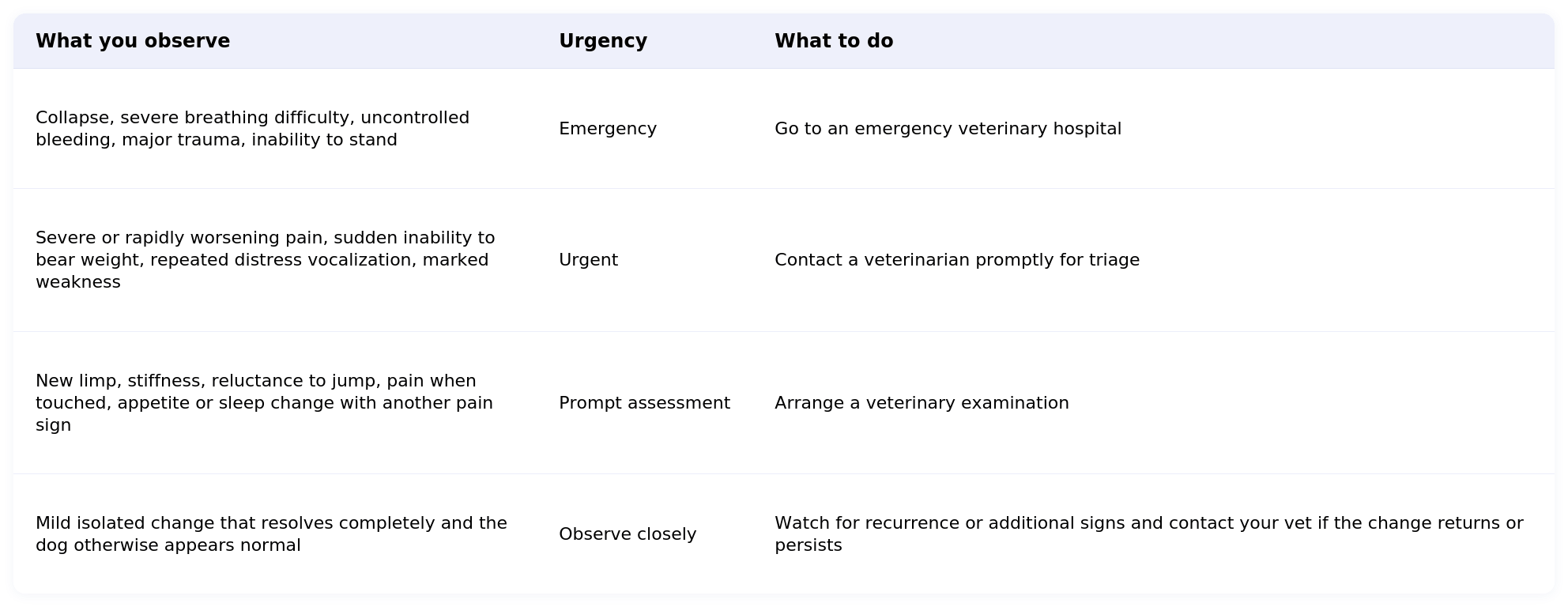
Before leaving for the clinic, keep the dog quiet and contained. Avoid unnecessary handling of a painful area. Do not give medication from your own medicine cabinet.
Bring a short timeline and any useful videos. AAHA specifically notes that owner-recorded photos and videos can facilitate pain assessment when behavior or movement looks different at home than it does in the clinic.
How to Comfort and Help Your Dog at Home
Home care should reduce strain while you arrange veterinary guidance. It should not replace diagnosis.
Pain suspected → reduce unnecessary activity → make movement safer → document the change → contact your veterinarian
Start with simple measures:
- provide soft, accessible bedding
- keep food and water easy to reach
- use non-slip rugs on slick flooring
- block unnecessary stair access
- use ramps where your dog already knows how to use them safely
- keep bathroom walks short and controlled if movement appears painful
For dogs with osteoarthritis, Cornell includes low-impact activity, non-slip rugs, and ramps among useful lifestyle modifications.
Be careful with heat and ice. The correct choice depends on the underlying problem, and the cause may not be obvious from the outside. Do not place a heating pad or ice pack directly against the skin or improvise prolonged treatment. Ask your veterinarian whether cold, warmth, or neither is appropriate for the suspected injury.
Medication requires the same caution. The FDA warns that human NSAIDs such as ibuprofen and naproxen can cause gastrointestinal problems as well as kidney or liver damage in dogs. Acetaminophen can also cause dose-dependent liver injury and other serious effects.
If your dog has swallowed a human pain medication, contact your veterinarian or the ASPCA Animal Poison Control Center at (888) 426-4435 promptly rather than waiting for symptoms to appear. ASPCA advises contacting poison control or a veterinarian after a potentially toxic ingestion even if the pet still appears normal.
What an Eating and Drinking History Can Add
Pain can sometimes appear alongside changes in appetite or drinking, but those changes do not identify where the pain comes from or what is causing it. A simple history of when eating or drinking changed can still give the veterinary team useful context alongside mobility, sleep, posture, medications, and other observations.
Hoomanely EverBowl™ learns a dog's normal eating and drinking patterns and recognizes when those patterns shift relative to that dog's individual baseline. That longitudinal record can help show whether intake changed around the same time as limping, withdrawal, difficulty rising, or another suspected pain-related change.
EverBowl does not detect pain, diagnose its cause, or determine how severe it is. The value is the record: a clearer history of eating and drinking changes to bring to the veterinary conversation.
Conclusion
Dogs do not need to cry for pain to be real. The signs your dog is in pain are usually quiet ones: a new limp, altered posture, reluctance to move, panting at rest, withdrawal, irritability, appetite changes, sleep disruption, or repeated licking.
Use the severity framework to decide how quickly to act, and take a short video when movement or behavior looks different at home. If the change is persistent, recurrent, severe, or accompanied by another concerning sign, contact your veterinarian rather than waiting for a more obvious symptom.
FAQs
1.What Position Do Dogs Lie in When They Are in Pain?
There is no single pain position. Cornell and AAHA note that painful dogs may hold an arched or hunched back, carry the head low, tuck the tail, position a limb unusually, struggle to change position, or repeatedly move because they cannot get comfortable. A new posture is more meaningful when it differs from the dog's usual way of resting.
2.How Does the 3-3-3 Rule Apply to Monitoring a Dog's Health?
It does not. The 3-3-3 rule is commonly used as a rough adjustment framework for newly adopted dogs, not as a veterinary method for assessing pain. For health changes, compare behavior and movement with the individual dog's normal baseline and document what changes over time.
3.Is It Safe to Use a Heating Pad for Canine Joint Pain?
Do not assume heat is appropriate just because a dog appears stiff. Heat can be useful in selected situations, but the right approach depends on the cause and stage of the problem. Ask your veterinarian before using a heating pad, and never place a hot surface directly against the dog's skin.
4.How Do Sleep Changes Indicate a Dog Is Hurting?
A painful dog may sleep more because activity is uncomfortable, or sleep less because it cannot settle into a comfortable position. Cornell lists altered sleeping patterns among possible pain-related changes. Sleep change alone is nonspecific; it becomes meaningful alongside stiffness, reduced activity, sensitivity to touch, or another departure from the dog's baseline.
5.Can a Dog Be Suffering Without Crying Or Whimpering?
Yes. Knowing how to tell if a dog is in pain means watching mobility, behavior, posture, activity, appetite, sleep, grooming, and reactions to touch rather than listening for vocalizing.
6.What Should I Do If My Dog Is Given Human Ibuprofen for a Limp?
Contact a veterinarian or animal poison-control service promptly rather than waiting for symptoms. The FDA warns that human NSAIDs such as ibuprofen may cause gastrointestinal injury and kidney or liver damage in dogs. Do not give another dose unless a veterinarian specifically instructs you to.