Bloat in Dogs: Signs, Symptoms, Emergency Treatment & Prevention
Bloat, or gastric dilatation-volvulus (GDV), is an acute veterinary emergency in which the stomach becomes distended and rotates, trapping gas and restricting blood flow. The pressure can reduce blood return to the heart, impair breathing, damage stomach tissue, and lead to shock. GDV does not resolve at home. It requires immediate stabilization and surgery. Cornell reports survival above 80% with medical and surgical treatment.
The signs to act on are unproductive retching, a swollen or painful abdomen, excessive drooling, pacing, pale gums, weakness, or collapse. Large, deep-chested dogs carry the highest risk, but GDV can occur in any dog. If you suspect bloat, do not wait for the abdomen to become visibly enlarged, attempt to induce vomiting, or try a home remedy. Call an emergency veterinary hospital and leave immediately.
The short version:
- Bloat (GDV) is a life-threatening emergency in which the stomach becomes distended and rotates. Without prompt veterinary treatment, GDV can rapidly progress to shock and death.
- The most urgent signs requiring immediate vet care are a hard, swollen belly, unproductive retching or dry heaving, and extreme restlessness.
- If you suspect bloat, call an emergency veterinarian immediately and transport your dog to the clinic; prompt action is critical for survival.
Signs of bloat in dogs
Behavioral signs
Owners typically notice a behavior change before they notice the belly itself.
Pacing, restlessness, and an inability to settle into a normal resting position are usually the first things people describe. This is often followed by dry heaving: repeated attempts to vomit that produce little more than foamy saliva, because the stomach's contents have nowhere to go.
Watch for repeated stretching, a hunched or arched posture, whining, or a dog that refuses to lie down and keeps shifting position. AAHA notes that dogs in the early stages of GDV often turn to look at their own side or flank, a response to sudden internal discomfort.
Physical signs
A dog's bloated stomach and abdominal pain are the common physical signs, but visible swelling may not be obvious early in every dog.
Alongside the swelling, watch for excessive drooling, rapid or shallow breathing, and pale or blue-tinged gums. A tense or painful abdomen is concerning, especially with retching or restlessness.
Subtle early symptoms of bloat in dogs
Early GDV may begin with restlessness, reduced appetite, repeated repositioning, or unusual withdrawal before abdominal enlargement becomes obvious. Because progression can be rapid, these signs deserve particular attention in a high-risk dog when they occur with retching, drooling, or abdominal discomfort.
These subtle, intermittent signs can precede rapid worsening by only a short window, sometimes less than an hour, which is why they shouldn't be written off as a bad day. If your dog is a deep-chested or large breed and shows even one or two of these subtle changes without an obvious explanation, call your vet immediately rather than waiting to see if it passes.
How bloat develops and who is at risk
GDV involves gastric distension and rotation of the stomach. Once volvulus occurs, normal emptying is obstructed, blood flow is compromised, and shock can develop rapidly.
Specific behaviors raise the odds of both stages happening. A dog that gulps air while eating too quickly increases stomach distension directly, and a large single daily meal gives the stomach more volume to work with than two or three smaller ones would.
Risk factors and breeds most affected
Anatomy and genetics carry the highest fixed risks. Large, deep-chested dogs, older dogs, and dogs with a first-degree relative affected by GDV are overrepresented. AAHA lists Great Danes, Standard Poodles, German Shepherds, Weimaraners, Irish and Gordon Setters, Doberman Pinschers, Boxers, and Saint Bernards among the breeds most commonly affected.
- Eating quickly or gulping large amounts of air
- One large meal a day instead of two or more smaller ones
- Vigorous exercise or excitement shortly before or after eating
- A nervous or anxious temperament
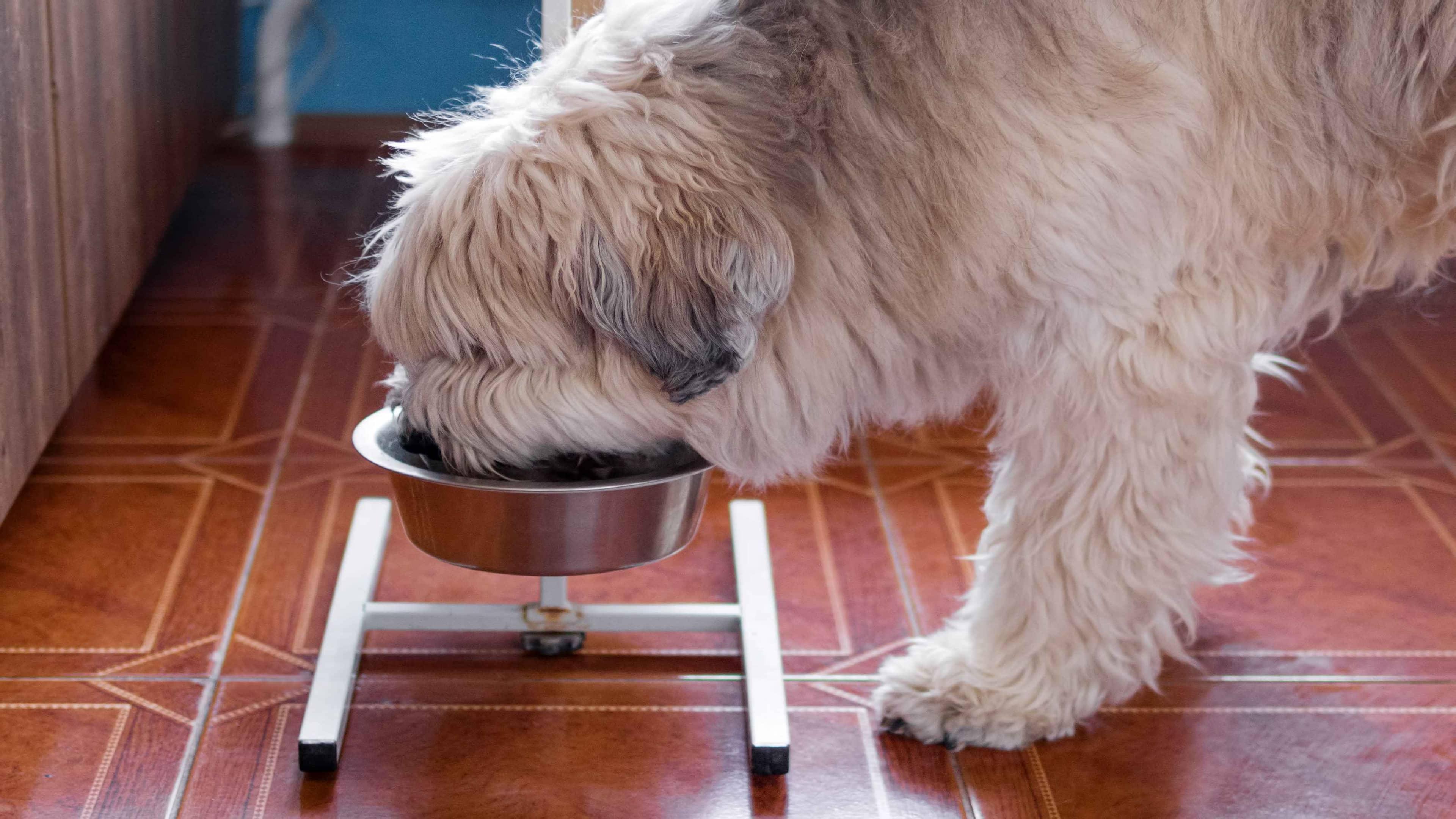
- Feeding from a raised bowl, which both AAHA and Cornell now list as a risk factor rather than a protective measure
What to do if you suspect bloat
Call an emergency veterinarian right now, keep your dog as calm and still as possible, and get to the clinic immediately. Do not wait to see if symptoms pass.
While you're getting ready to leave, avoid handling your dog's abdomen more than necessary and don't offer food, water, or anything by mouth.
Immediate steps to take
- Call the nearest emergency hospital and say you suspect GDV.
- Leave immediately.
- Keep the dog as calm and safely restrained as possible during transport.
What not to do
A few instinctive reactions can cost your dog time it doesn't have.
- Do not try to induce vomiting; the twisted stomach usually can't pass anything up regardless, and trying wastes time
- Do not give home remedies, anti-gas products, or any medication without a vet's direction
- Do not offer food or water, even if your dog seems to want it
- Do not wait to see if the symptoms improve on their own; GDV does not resolve without treatment
Emergency checklist to share
Keep this information ready to give the clinic, either from memory or a phone note, so nothing gets lost in the moment.
- Your nearest emergency vet's phone number, saved before you ever need it
- The specific signs you're seeing and when each one started
- The time of your dog's last meal and roughly how much they ate
- Your dog's breed, age, and approximate weight
- Any history of GDV in this dog or a close relative
- Current medications or recent diet changes
Emergency treatment and what vets do
Once you arrive, the clinical team moves through a fairly consistent sequence: rapid triage and exam, imaging and bloodwork to confirm GDV and gauge severity, stabilization, and then surgery. Roughly, the pathway looks like this:
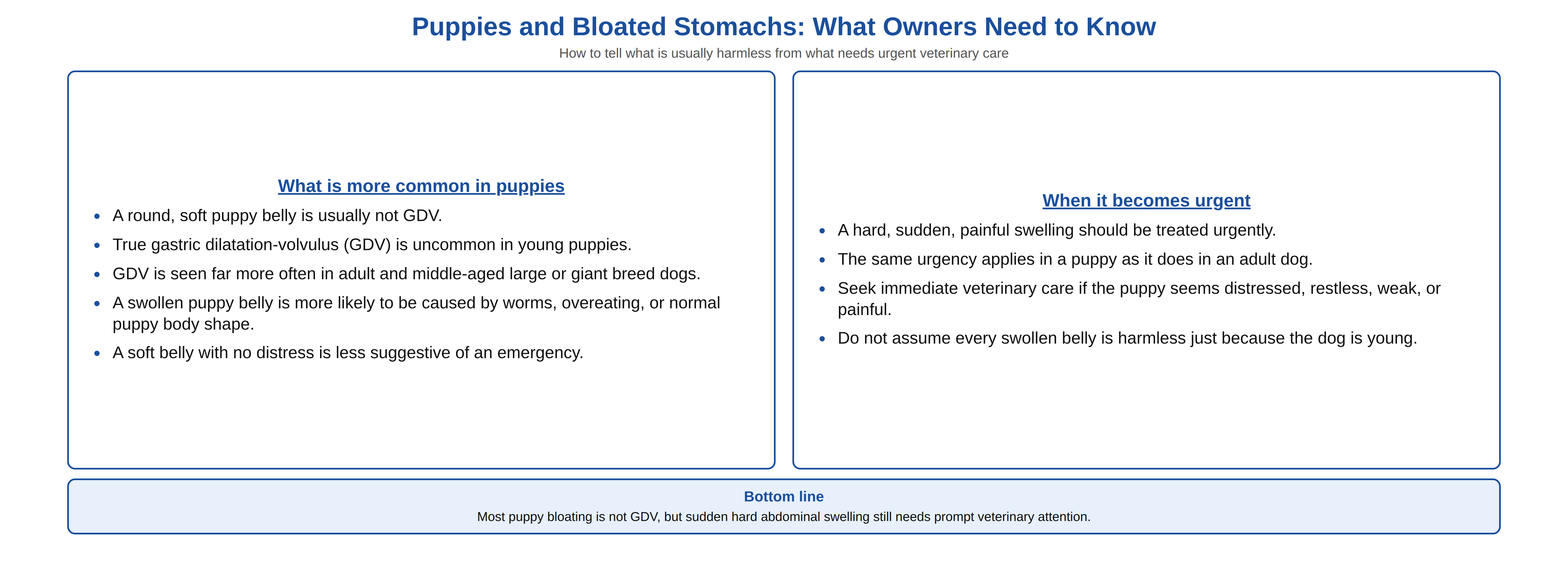
Treatment starts with stabilization. IV fluids support circulation and blood pressure, pain relief reduces distress, and oxygen may be used if needed. The stomach is then decompressed to release trapped gas and reduce pressure on surrounding organs and major blood vessels. Radiographs confirm whether the stomach has rotated, while bloodwork helps assess shock, electrolyte changes, and tissue stress.
If volvulus is confirmed, surgery is required. The surgeon returns the stomach to its normal position, checks for tissue damaged by loss of blood flow, and performs a gastropexy to reduce the risk of future twisting. Post-operative monitoring focuses on arrhythmias, pain, circulation, and recovery.
Triage and diagnostics
The vet team starts with a fast physical exam to assess how distended and painful the abdomen is and how your dog is doing overall, including heart rate, gum color, and breathing.
Radiographs confirm whether the stomach has simply dilated or has actually twisted, which changes the urgency and the surgical plan. Bloodwork, including a lactate level, helps the team judge how much the twisting has already affected blood flow and tissue health, information that shapes both the anesthesia plan and what to expect in surgery.
Stabilization steps
Before surgery, the priority is getting your dog stable enough to safely undergo anesthesia.
- IV fluids to counter shock and support blood pressure
- Oxygen support to offset reduced oxygen delivery from compromised blood flow
- Pain relief, since GDV is intensely painful
- Stomach decompression, usually with a needle through the abdominal wall or a tube passed from the mouth, to release trapped gas
Surgery and gastropexy
Surgery has three goals: untwist the stomach, check whether any tissue has died from lost blood flow, and remove any of that tissue if present, which sometimes includes part of the stomach or the spleen.
Once the stomach is back in position, the surgeon performs a gastropexy, suturing the stomach to the abdominal wall so it can't twist again. Cornell reports this drops the recurrence rate from as high as 80 percent without it to roughly 3 to 5 percent with it. After surgery, dogs are monitored closely for heart arrhythmias, kept on pain control, and reintroduced to food gradually rather than given a full meal right away.
Prognosis and outcomes
GDV remains life-threatening even with treatment. Cornell reports survival above 80% with medical and surgical treatment. A worse prognosis is associated with delayed treatment, persistent high lactate levels, necrotic stomach tissue requiring removal, and splenic involvement. A 1999 study in the Journal of the American Veterinary Medical Association found that elevated preoperative lactate was associated with a higher likelihood of gastric necrosis and poorer survival outcome.
Practical steps for preventing bloat in dogs
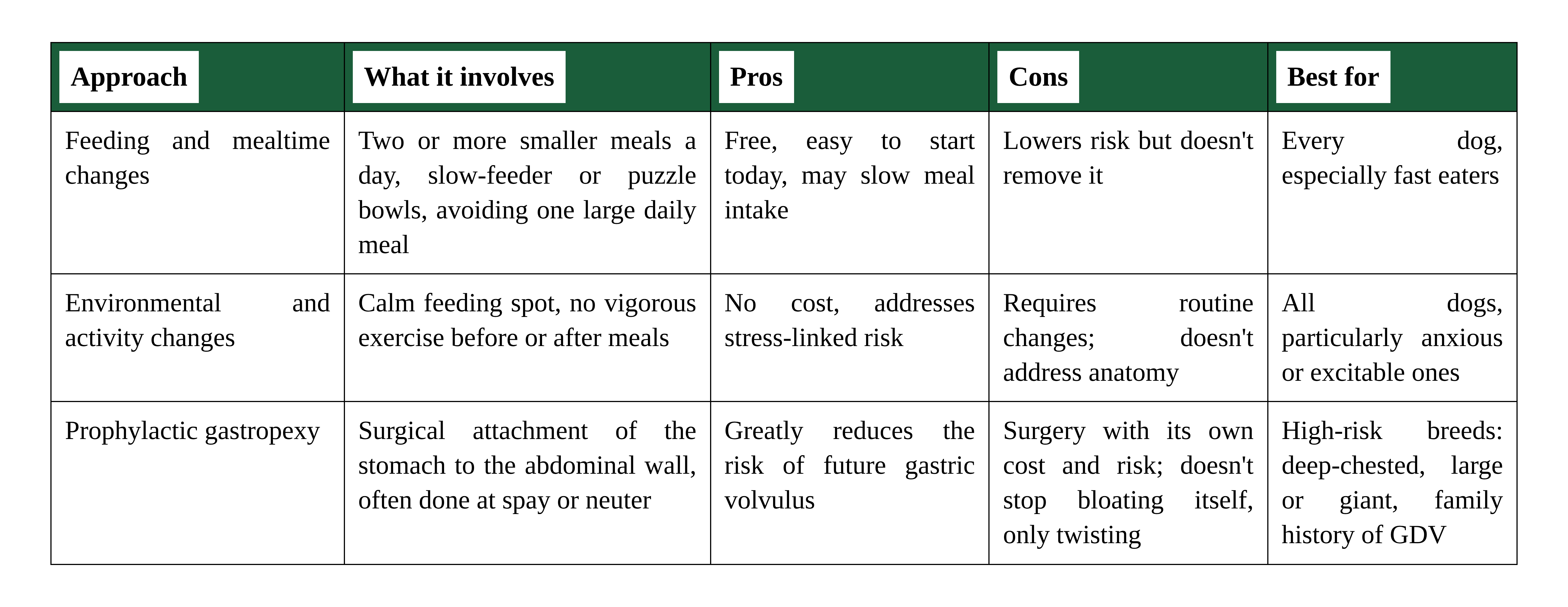
Feeding and mealtime strategies
Feeding practices may modify some GDV risk factors, but they cannot eliminate risk.
- Split daily food into two or more smaller meals rather than one large one
- Measure portions instead of free-feeding large amounts at once
- A slow-feeder may be useful for dogs that gulp meals, although it does not eliminate GDV risk.
Environmental and activity changes
For high-risk dogs, avoid strenuous exercise immediately before and after meals. Your veterinarian can advise on timing for your dog's risk profile.
Do not use an elevated bowl specifically to prevent GDV unless your veterinarian recommends one for another medical reason. Cornell and Merck list elevated feeding as a GDV risk factor.
When to discuss gastropexy with your vet
Prophylactic gastropexy is most often recommended for deep-chested, large, or giant breeds, or any dog with a close relative that has had GDV. It's commonly performed at the same time as a spay or neuter, since your dog is already under anesthesia, though it can also be done as its own procedure at any age.
Understanding your dog for early signs of bloat
A record of appetite and drinking patterns can provide useful context over time.
EverBowl learns your dog's normal eating and drinking patterns over time. That record can provide useful context about appetite or intake changes when you speak with your veterinarian.
EverBowl™ does not diagnose GDV, identify whether GDV is occurring, or replace emergency veterinary assessment. GDV can develop acutely. If your dog is retching without producing vomit, pacing, showing abdominal pain, or developing a swollen abdomen, do not wait for additional pattern data. Go to an emergency veterinary hospital.
Puppies and bloated stomachs: What owners need to know
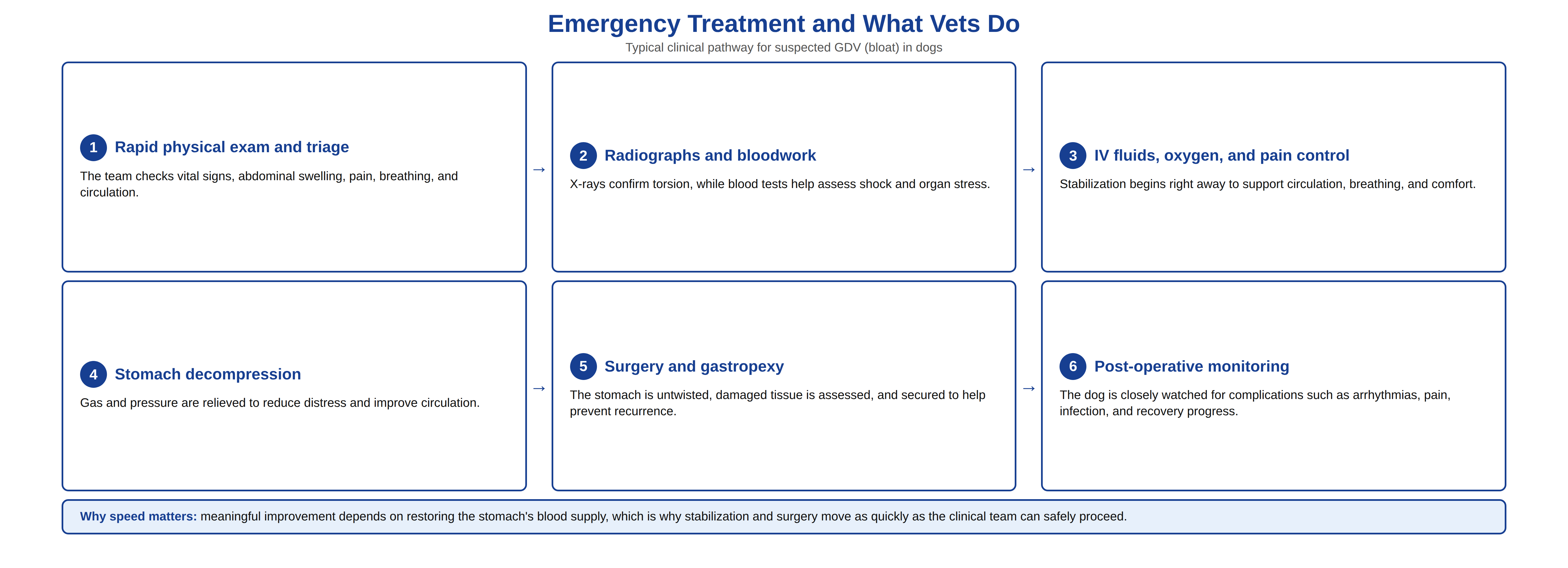
A rounded puppy belly is far more often linked to intestinal parasites, overeating, constipation, or normal body shape than GDV. True gastric dilatation-volvulus is uncommon in young puppies and is seen much more often in adult, large, deep-chested dogs.
What changes the urgency is how the abdomen looks and how the puppy feels. A sudden, hard, painful swelling with repeated retching, weakness, pale gums, or marked distress needs immediate veterinary care. Age alone does not rule out a serious abdominal emergency.
Non-Emergency causes of a puppy's bloated stomach
Some could be intestinal parasites, overeating, constipation, or a normal body shape rather than GDV. Roundworms are a common cause of a pot-bellied appearance and require appropriate deworming.
These causes usually develop gradually and are less likely to produce a hard, painful abdomen, repeated retching, or sudden weakness. If any of those signs appear, treat it as an emergency.
When a puppy's bloated stomach becomes an emergency
A suddenly enlarged, tense, painful abdomen with repeated retching, weakness, or pale gums requires emergency care. The same emergency signs apply regardless of age. Don't assume young age rules out GDV; while it's less common, it isn't impossible, and the same urgency applies.
Conclusion
Bloat in dogs is a rapid, life-threatening emergency that needs immediate veterinary care. Suspected GDV has no safe home treatment. Immediate veterinary stabilization and surgery are required when volvulus is confirmed.
Early recognition and fast transport to an emergency clinic are what actually move the survival odds in your dog's favor. Alongside that, practical prevention, smaller meals, a calm feeding routine, and a conversation with your vet about gastropexy for high-risk dogs meaningfully lower the chance you're ever in that emergency at all. If you're ever unsure whether what you're seeing is bloat, call your vet.
FAQs
1. Will dog bloat go away on its own?
No. GDV does not resolve without veterinary treatment. Other causes of abdominal gas or enlargement may be less serious, but owners cannot reliably distinguish them from GDV at home when emergency signs are present.
2. What can be mistaken for bloat in dogs?
Overeating, gas, constipation, and other causes of abdominal swelling like fluid buildup or organ enlargement can look similar early on. The distinguishing signs of true GDV are a hard, tightly distended belly combined with unproductive retching and restlessness that doesn't ease. When in doubt, treat it as an emergency and let a vet examine your dog.
3. Would a dog with bloat lie down?
Usually not comfortably. Most dogs with GDV are restless, pace, and struggle to find a comfortable position rather than settling down normally. A dog that seems unable to get comfortable, especially alongside a swollen belly, is showing a classic sign rather than an unusual one.
4. How can I get air out of my dog's stomach at home?
You can't safely do this, and trying puts your dog at further risk. There's no effective home remedy or over-the-counter product for GDV. Decompressing the stomach requires veterinary equipment and needs to happen at a clinic, not at home.
5. Why is my dog's belly so big and hard?
A suddenly enlarged, tense, painful abdomen can occur with GDV and other serious abdominal conditions. If it appears with retching, restlessness, weakness, or pale gums, go to an emergency clinic immediately.
6. Is it normal for puppies to have a potbelly?
A soft, round belly is common in puppies and is often linked to parasites, a bit of overeating, or their normal body shape at this age. A puppy's stomach bloated hard, suddenly, or alongside vomiting, lethargy, or pain is a concern, at which point it needs the same urgency as an adult dog's symptoms would.