How to Stop a Dog From Barking: Causes, Training Tips & Solutions

Barking is normal canine communication, and reducing it starts with identifying why the dog is barking rather than simply trying to silence the sound. Sudden barking accompanied by pain, disorientation, breathing difficulty, collapse, or another acute physical change needs veterinary attention before it is treated as a training problem.
For most dogs, the practical plan is three-part: identify the trigger, prevent repeated practice of the unwanted response, and teach a behavior that works better in the same situation. One useful step today is to block a predictable trigger for an hour, such as closing the curtains where your dog normally reacts to passersby, and note whether the barking changes. Humane World for Animals recommends this kind of environmental management as an early step in reducing repeated barking.
The Short Version
- Barking can communicate alertness, excitement, fear, frustration, attention-seeking, boredom, or distress. ASPCA recommends identifying the function of the barking before choosing a training response.
- A useful training sequence is identify the trigger → reduce opportunities to rehearse the barking → reward a calm alternative behavior.
- Closing curtains, adding distance from a trigger, using barriers, or reducing access to predictable sounds can lower arousal enough for learning to happen.
- Reward-based methods are preferred over yelling, shock collars, spray collars, and other aversive techniques. AVSAB recommends reward-based training and advises against aversive methods because of welfare risks.
How to Stop Dog Barking
To stop problem barking, first work out what starts it and what the dog gets from doing it. Then change the environment so the dog practices the barking less often and teach a quieter response that earns reinforcement instead.
ASPCA notes that barking serves different functions. A dog barking at someone outside the window needs a different plan from a dog barking because a person has left the home.
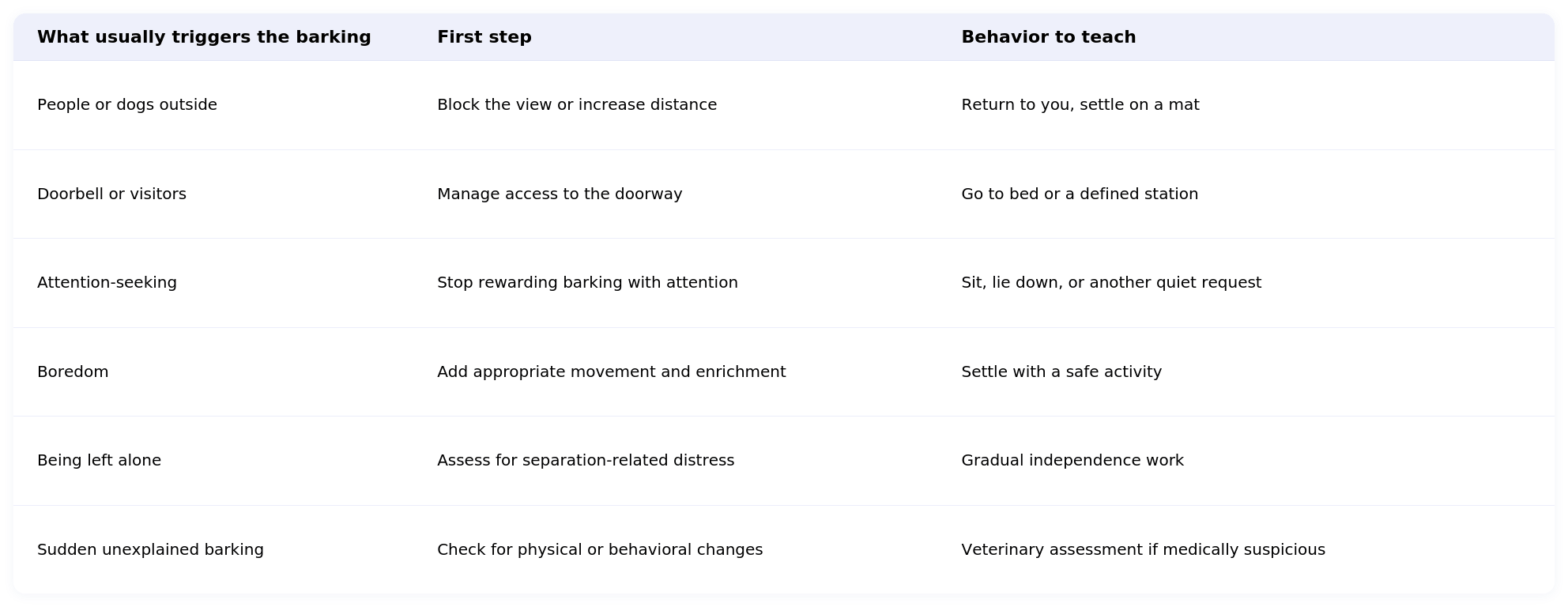
For visual triggers, close curtains or move the dog farther from the window. For predictable noises, reduce exposure where possible. If the dog is already highly aroused, asking for complex obedience usually adds frustration rather than teaching calm.
Hoomanely's guide to reading between the barks explains how context around vocalization can help clarify what the dog is communicating.
How to Get a Dog to Stop Barking
Start with motivation, not volume.
A territorial bark at the front window may be reinforced because the person outside eventually walks away. Attention barking may continue because someone looks, talks, touches, feeds, or gets up every time it happens. Fear-based barking has a different function again: the dog may be trying to increase distance from something uncomfortable.
Management and training work together. Management keeps the dog from practicing the same response dozens of times each day. Training gives the dog another response to use instead.
First-week goals:
- identify the two or three most predictable barking triggers
- reduce exposure to one trigger you can control
- choose one alternative behavior, such as going to a mat
- reward quiet behavior before barking starts
- note whether barking occurs only in one context or across many situations
The kindest way to train a dog to stop barking is to reward the response you want in the exact situation that used to produce the noise.
Do not judge progress by whether the dog becomes completely silent. A more useful early sign is that the dog recovers sooner, responds at a lower intensity, or can disengage from the trigger more easily.
How to Get My Dog to Stop Barking
If the cause is unclear, answer three questions:
- When does the barking happen?
- What happens immediately before it?
- What happens immediately after it?
That short sequence often reveals what is maintaining the behavior.
Attention-seeking → stop rewarding barking itself and reinforce a quiet request such as sitting.
Alert barking → reduce access to the visual or sound trigger, then teach the dog to move away and settle.
Boredom or under-stimulation → review the dog's exercise, sniffing, play, training, and opportunities to use normal canine behaviors.
Separation-Related barking → look for pacing, panting, destruction, house-soiling, escape attempts, or distress that begins around departure.
Sudden unexplained barking → consider pain, sensory changes, cognitive changes, or another health problem before assuming the behavior needs training. ASPCA specifically recommends ruling out illness or injury when barking appears to be pain-related.
Hoomanely's guide to behavior changes that can signal illness is useful when barking changes alongside appetite, sleep, mobility, social behavior, or normal routines.
Identify Triggers and Prevent Rehearsal
“Prevent rehearsal” simply means reducing how often the dog gets to practice the unwanted response while training is underway.
Try this:
- Observe: note the sight, sound, person, movement, or event immediately before barking.
- Change the setup: close curtains, use a gate, increase distance, move the resting spot, or reduce exposure to predictable noise.
- Reward the alternative: reinforce the dog for turning away, coming to you, settling, or staying on a mat before barking escalates.
Humane World specifically recommends removing or reducing the trigger where possible and teaching an incompatible behavior, such as going to a bed when visitors arrive.
Management is not cheating. It creates a situation in which the dog is capable of learning.
Meet Your Dog's Needs and Enrichment
Exercise helps, but more exercise is not automatically the answer to every barking problem.
Dogs also need opportunities to sniff, explore, chew safely, solve simple problems, play, interact socially when appropriate, and rest without interruption. A peer-reviewed pilot study of environmental enrichment in dogs found increases in relaxation behavior and reductions in alert and stress behaviors after enrichment activities, although the study was small and does not establish a universal daily time requirement.
A realistic day might include:
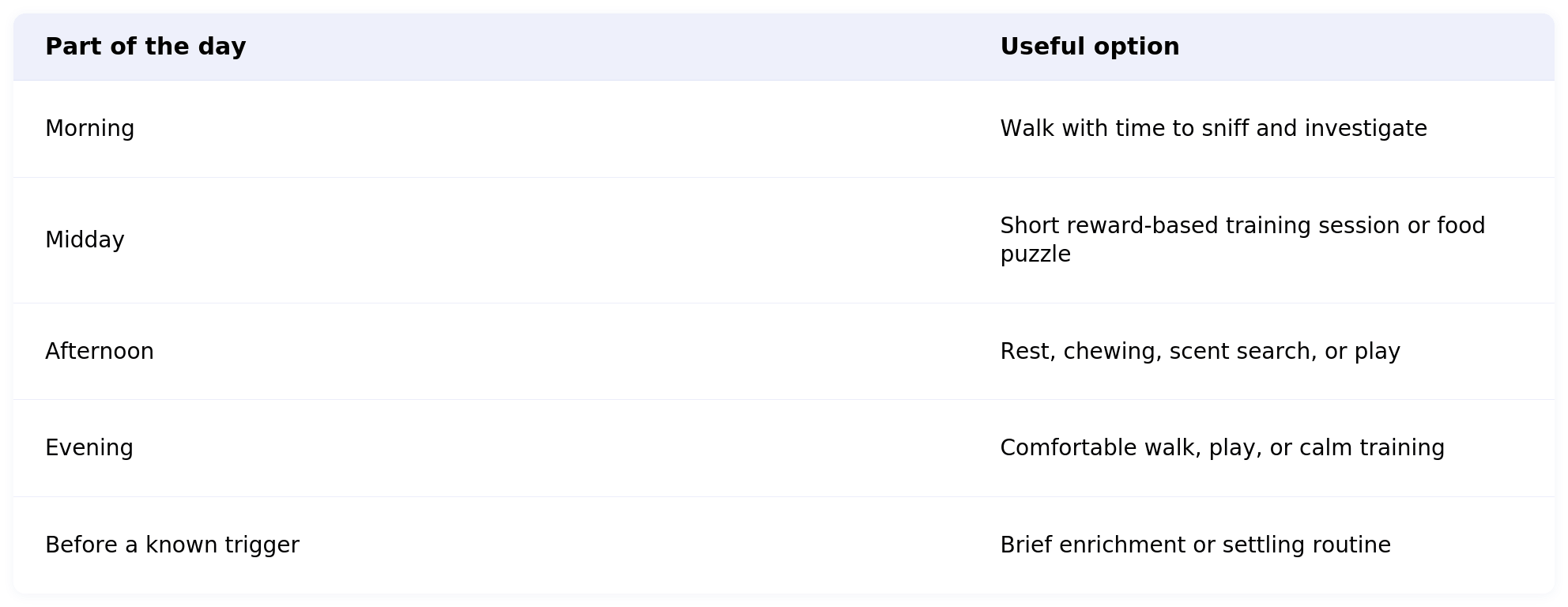
The right amount depends on age, breed, health, fitness, temperament, and the type of barking. A senior dog with arthritis and an adolescent working breed should not be given the same exercise prescription.
Supervise new chew items and food toys. Choose items appropriate to the dog's size and chewing style, and keep toxic foods such as xylitol-containing products, grapes, and raisins out of enrichment toys.
Train for Doorbells, Leaving, and Calls
Doorbell barking, separation distress, and barking during work calls can sound similar from another room, but they need different plans.
Doorbell Training Protocol
In practice: teach a predictable place to go before adding the full-intensity doorbell.
- Choose a bed or mat away from the door.
- Reinforce the dog for going there without a visitor present.
- Introduce a quiet doorbell recording or gentle knock at an intensity that does not trigger full barking.
- Immediately reward going to the mat and remaining there.
- Increase sound intensity gradually.
- Practice with one familiar helper before using the routine during real arrivals.
- Keep physical control of the situation if the dog may rush, jump on, or frighten a guest.
Humane World recommends teaching dogs to go to a bed and gradually adding the door-opening and doorbell components as reliability improves.
Separation-Related Barking
Barking after a person leaves is not automatically separation anxiety.
ASPCA notes that separation anxiety often includes other distress signs such as pacing, destruction, house-soiling, escape attempts, or agitation around departure cues. Merck similarly lists distress vocalization, pacing, inability to settle, destructive behavior, and other signs, and recommends ruling out alternative causes before diagnosing separation distress.
Start with:
- video of the first part of an absence
- comfortable short periods of independence while you are home
- a safe resting area
- gradual departures that stay below the dog's panic threshold
Do not repeatedly leave a panicking dog alone to “get used to it.” Severe distress, self-injury, escape attempts, or inability to tolerate very short absences warrants veterinary or veterinary-behaviorist help.
Hoomanely's guide to separation anxiety in dogs covers that problem in more detail.
Managing Barking During Calls
Set the dog up before the meeting starts rather than waiting for barking to begin.
- Move the dog away from a predictable window or hallway trigger.
- Offer a safe, supervised chew or enrichment activity if appropriate.
- Practice short mat-settle sessions outside work hours so the behavior is familiar when you need it.
In a multi-dog household, separate dogs for chews or food toys if resource guarding or competition is possible.
What Not to Do and When to Get Help
Nothing you can buy will make a dog stop barking overnight, and the tools that promise it are the ones to avoid.
Yelling may sound like more noise to an already aroused dog and does not address why the barking started. Humane World specifically advises against yelling as a barking solution.
Avoid shock collars, spray collars, harsh physical corrections, and deliberate startling as routine solutions. AVSAB's current position is that reward-based methods should be used for dog training and behavior modification, and that aversive methods should not be used. A peer-reviewed study of 92 companion dogs also found poorer welfare indicators in dogs trained with aversive-based methods compared with reward-based training.
Seek professional help when barking occurs with:
- panic or inability to settle
- self-injury or frantic escape attempts
- aggression or serious reactivity
- sudden major escalation without an obvious environmental explanation
- signs of pain, confusion, sensory decline, or illness
- a behavior problem that is worsening despite consistent reward-based work
A veterinarian should assess possible medical causes. For significant fear, anxiety, aggression, or separation distress, ask about referral to a board-certified veterinary behaviorist or another appropriately qualified reward-based behavior professional.
What an Eating and Drinking Baseline Can Add
A sudden change in barking can sometimes appear alongside other changes at home. A dog may become unusually vocal while also eating less, drinking differently, sleeping poorly, moving differently, or withdrawing from normal interaction.
Hoomanely EverBowl™ learns a dog's normal eating and drinking patterns and recognizes when those patterns shift relative to that dog's individual baseline.
That context can help:
- establish whether eating or drinking changed around the same time as the behavior
- build a clearer timeline for a veterinary conversation
- add longitudinal context to what the owner is seeing at home
EverBowl does not diagnose anxiety, determine why vocalization has changed, or replace behavior training or veterinary assessment. The value is the record. Training addresses the barking itself. Veterinary assessment is what determines whether pain, illness, or another health problem could be contributing.
Conclusion
The most effective way to stop dog barking is to understand what the bark is doing for the dog. Manage the trigger, reduce repeated practice of the unwanted response, meet the dog's physical and behavioral needs, and reinforce a quieter alternative.
Start with one predictable situation this week rather than trying to eliminate every bark at once. If the barking involves panic, self-injury, aggression, sudden unexplained change, or signs of illness, bring in professional help instead of escalating punishment.
FAQs
1.What Is the 3-bark Rule?
There is no universal veterinary or evidence-based “3-bark rule” that every dog should follow. Some trainers use three barks as a household guideline before cueing a dog to disengage, but the number itself does not address why the dog is barking. A better plan is to teach a clear alternative response and reinforce it consistently.
2.How Long Does It Take to See Progress in Bark Training?
There is no single timeline. Humane World notes that dogs that have practiced barking for longer may take longer to develop a different response, and desensitization work may take days or weeks. Progress should be judged by the dog's ability to disengage, recover, and respond to the alternative behavior, not only by complete silence.
3.Can Background Noise Help Reduce Alert Barking?
It can help when outside sounds are a predictable trigger. Background sound, moving the dog to a quieter room, closing windows, or increasing distance can reduce exposure while you teach another response. These are management tools, not substitutes for training.
4.Is Ignoring Barking Effective in Every Situation?
No. Ignoring can be useful for barking that reliably produces human attention, provided the dog's physical and emotional needs have already been met. It is inappropriate as a blanket response to fear, pain, separation distress, or barking at an environmental trigger. The cause determines the plan.
5.When Is Excessive Barking a Medical Concern?
A sudden or unexplained change deserves more attention when it appears with pain, altered appetite or drinking, mobility changes, confusion, sleep disruption, loss of house-training, or another physical or behavioral change. ASPCA recommends veterinary assessment to rule out illness or injury when a medical cause may be contributing to barking.