Normal Dog Heart Rate: Average BPM by Age, Size & Activity Level

A normal resting dog heart rate depends on age and size. BluePearl lists practical resting reference ranges of 120–160 BPM for puppies, 100–160 BPM for small adult dogs, and 60–100 BPM for medium-to-large adult dogs.
Collapse, severe weakness, labored breathing, blue or gray gums, or an abnormal heartbeat accompanied by fainting needs urgent veterinary care rather than repeated pulse checks at home. Merck notes that heart rate can also rise with exercise, excitement, pain, and fever, so the most useful comparison is a calm resting reading against your own dog's usual pattern.
The Short Version
- Resting heart rate varies with size and age. BluePearl’s resting reference ranges are 120–160 BPM for puppies, 100–160 BPM for small adult dogs, and 60–100 BPM for medium-to-large adult dogs.
- Measure only when your dog is calm and resting. Exercise, excitement, pain, fever, and stress can temporarily increase heart rate.
- A slightly irregular rhythm can be normal. Respiratory sinus arrhythmia causes the heart to speed up during inhalation and slow during exhalation in healthy resting dogs.
- Symptoms matter as much as the number. Collapse, fainting, severe weakness, breathing difficulty, or blue or gray gums alongside an abnormal rate or rhythm warrants urgent veterinary attention.
What Is a Normal Dog Heart Rate?
For a calm dog at rest, the normal range depends heavily on body size and age. Larger dogs generally sit toward the lower end, while small dogs and puppies run faster.
Merck’s general resting reference for dogs is 70–120 BPM, while smaller dogs tend to have faster rates than larger dogs. For a size-specific comparison, BluePearl lists 100–160 BPM for small breed dogs, 60–100 BPM for medium-to-large dogs, and 120–160 BPM for puppies.
These figures are not contradictory. Merck provides a broad canine reference, while BluePearl separates resting rates by age and body size.
Heart rate varies because of:
- age: puppies tend to have faster rates
- size: smaller dogs generally beat faster than larger dogs
- activity: exercise temporarily increases demand on the cardiovascular system
- emotion: excitement and stress can raise the rate
- health: pain, fever, reduced circulating blood volume, heart disease, and other illnesses may change heart rate
One irregularity is often normal. Respiratory sinus arrhythmia is the normal rise in heart rate during inhalation and fall during exhalation seen in many quiet, healthy dogs. Merck describes it as a normal canine rhythm rather than a pathologic arrhythmia.
A 2021 peer-reviewed study of resting dogs also documented pronounced respiratory sinus arrhythmia, with substantial variation among individual dogs.
Heart Rate Ranges by Dog Size and Age
Use these figures as resting reference ranges, not as a diagnosis. The size- and age-specific resting ranges below come from BluePearl’s emergency-care guidance.
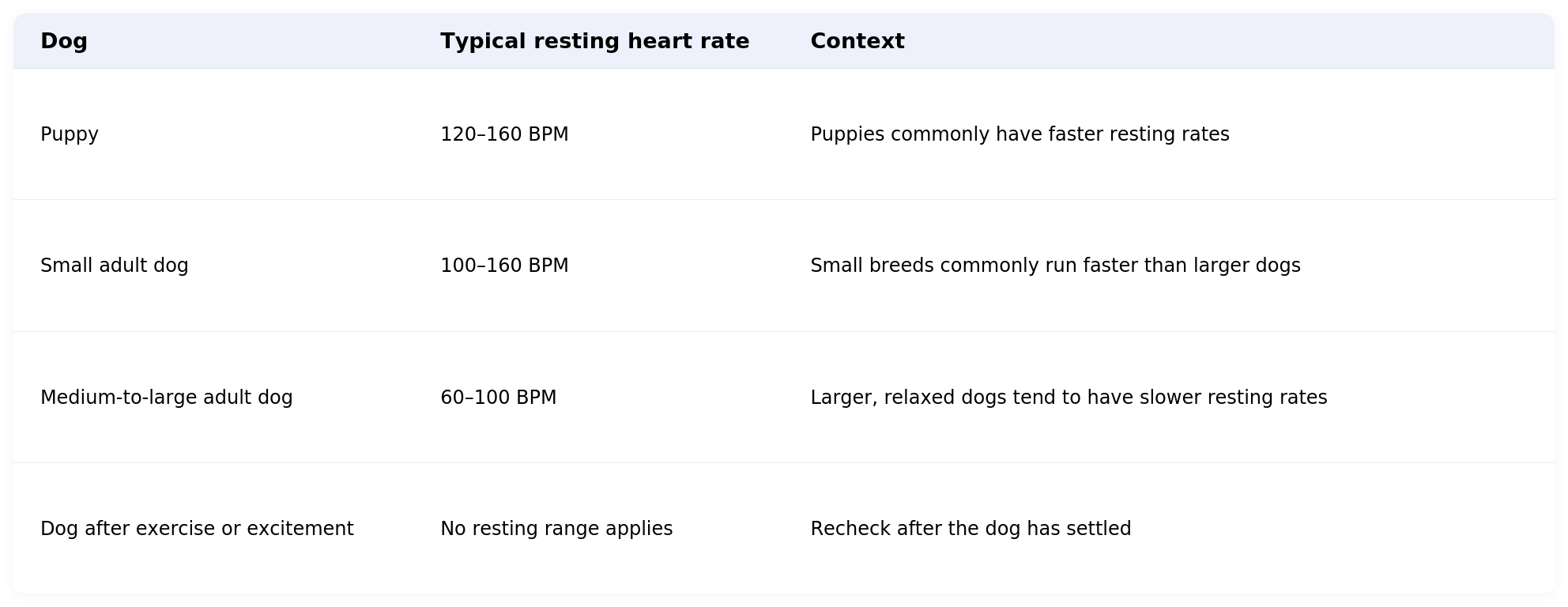
Do not compare a post-walk pulse with a sleeping measurement. Exercise, stress, pain, and fever can all temporarily raise heart rate. What matters is whether the rate returns toward your dog's usual resting pattern once the trigger has passed.
BluePearl lists a puppy resting heart rate of 120–160 BPM, a range that would be unusually high for a relaxed medium-to-large adult dog.
Age matters too. A large 8-year-old dog and a 10-week-old puppy should not be judged against the same reference. A 2025 prospective study following 703 apparently healthy dogs found that resting heart rate changed with age, body weight, breed, time of day, and other factors. Heart rates were also lower at night than during the day.
That is why a baseline is more useful than chasing one universal “perfect” number.
How to Measure Your Dog's Heart Rate
Check heart rate when your dog is lying or sitting quietly, not panting and not immediately after play, a walk, or an exciting event.
You can feel either the heartbeat over the chest or the femoral pulse in the upper inner thigh. VCA identifies the femoral artery as the useful palpable pulse in dogs, while BluePearl describes the heartbeat as easiest to feel near the point where the left elbow meets the chest.
Use this five-step method:
- Let your dog settle in a comfortable position.
- Place your fingers on the inner upper thigh to find the femoral pulse, or place your hand over the left side of the chest behind the elbow.
- Count the beats for 15 seconds.
- Multiply the count by 4 to calculate beats per minute.
- Note the result along with the time and what your dog was doing beforehand.
For example:
22 beats in 15 seconds × 4 = 88 BPM.
An 88 BPM resting rate fits comfortably within the reference range for many medium or large adult dogs.
If you cannot find a pulse, do not keep pressing harder into the thigh. Try the chest instead. A stethoscope can make the heartbeat easier to hear if you already have one, but consumer phone apps should not be treated as a substitute for veterinary ECG assessment.
Consistency matters more than taking repeated readings in one sitting. Use similar conditions each time.
When to Worry About Your Dog's Heart Rate
An unusual number does not automatically mean heart disease. Context comes first.
A heart rate may rise because your dog has just run upstairs, heard the doorbell, become frightened, developed a fever, or is experiencing pain. Merck identifies exercise, stress, fever, pain, blood-volume changes, and cardiac disease among causes of sinus tachycardia.
Recheck once your dog is calm if the only finding is an unexpected number.
Seek veterinary advice when:
- the resting rate remains clearly outside your dog's usual range on repeat calm checks
- the rhythm repeatedly feels irregular in a way that does not follow breathing
- you notice unexplained weakness or exercise intolerance
- your dog develops a persistent change alongside coughing, rapid breathing, or reduced activity
Seek emergency veterinary care for:
- collapse or fainting
- severe weakness
- labored or distressed breathing
- blue, gray, or markedly pale gums
- an abnormal heartbeat with significant clinical distress
Merck lists weakness, syncope, difficulty breathing, cyanosis, and exercise intolerance among cardiovascular warning signs, while Cornell considers blue gums, difficulty breathing, weakness, and collapse signs of respiratory emergency.
If a new heart-rate change appears alongside a broader shift in routine, Hoomanely's guide to behavior as an early sign of illness can help you put those changes into context.
Dog Heart Rhythm and Arrhythmias
Heart rate tells you how many times the heart beats in a minute. Heart rhythm describes the pattern and timing of those beats. They are related, but they are not the same thing.
A resting dog may have respiratory sinus arrhythmia, where the heart speeds up while breathing in and slows during breathing out. That can be completely normal. A pathological arrhythmia is an abnormality in the rate, regularity, or origin of the heart's electrical impulses.
Abnormal rhythms can occur with primary heart disease or systemic problems. Merck notes that electrolyte disturbances, heart disease, drugs, and other conditions can affect cardiac rhythm. Some breeds are also predisposed to specific arrhythmias. Cornell, for example, describes inherited or breed-associated rhythm disorders in Boxers, German Shepherds, Bulldogs, and other dogs.
At home, you might notice:
- repeated pauses that do not seem linked to breathing
- unusually rapid or slow beats while resting
- an irregular pulse
- weakness or fainting around an episode
You cannot identify the exact arrhythmia by touch.
An electrocardiogram (ECG) evaluates the heart's electrical rhythm. A Holter monitor provides a longer ECG recording, commonly over 24 hours, so intermittent abnormalities can be compared with the dog's activity. An echocardiogram evaluates heart structure and function.
Home Monitoring and Keeping Baseline Records
A baseline answers a more useful question than “Is this number normal for dogs?”
It answers: Is this normal for my dog?
A recent prospective study following 703 dogs found meaningful effects of age, body weight, breed, circadian timing, and season on resting heart and respiratory rates. That supports interpreting repeated readings in context rather than relying on a single population average.
For a simple starter baseline:
- take one calm resting reading each day for 7 days
- use roughly similar conditions where practical
- note time, position, and recent activity
- record whether the rhythm felt steady or varied with breathing
- note any symptoms such as coughing, weakness, reduced appetite, or altered breathing
The seven-day log is a personal record-keeping method only. It is not a diagnostic test, medical cutoff, or substitute for a veterinarian’s monitoring plan.
A phone note or small notebook is enough. Bring the record to appointments if something changes.
Hoomanely's article on why baseline health data matters explains the wider value of comparing a dog with their own normal pattern rather than with population averages alone.
What an Eating and Drinking Baseline Can Add
Heart rate is a cardiovascular measurement. Eating and drinking patterns cannot tell you what the heart is doing.
Hoomanely EverBowl™ learns a dog's normal eating and drinking patterns and recognizes when those patterns shift relative to that dog's individual baseline. If a heart-rate concern appears at the same time as reduced appetite or a meaningful change in drinking, that longitudinal context can make the timeline clearer for your veterinarian.
EverBowl does not measure heart rate, diagnose arrhythmias, identify heart disease, or determine whether a cardiovascular emergency is occurring. The value is the record. An abnormal heart rate accompanied by collapse, fainting, breathing difficulty, or abnormal gum color requires direct veterinary assessment.
Conclusion
Using BluePearl’s resting reference ranges, puppies are typically 120–160 BPM, small adult dogs 100–160 BPM, and medium-to-large adult dogs 60–100 BPM.
Measure only when your dog is calm, and compare the reading with their own established resting pattern rather than with an isolated number taken after activity.
A rhythm that rises and falls with breathing can be normal respiratory sinus arrhythmia. Persistent changes, repeated unexplained irregularities, weakness, fainting, breathing difficulty, or abnormal gum color deserve veterinary attention. Start by taking a calm resting pulse today and recording the conditions around it.
FAQs
1.Is a Dog's Heart Rate Higher Than a Human's?
It often is, particularly in puppies and small dogs, where the average dog heart rate at rest can approach double a typical human's. BluePearl lists practical resting reference ranges of 120–160 BPM for puppies, 100–160 BPM for small adult dogs, and 60–100 BPM for medium-to-large adult dogs.
Merck also lists 70–120 BPM as a general canine resting reference and notes that smaller dogs tend to have faster heart rates than larger dogs.
2.Is It Normal for My Dog's Heartbeat to Pause Occasionally?
A resting dog's rhythm can feel irregular because of respiratory sinus arrhythmia, where the rate rises during inhalation and falls during exhalation. That is common in healthy dogs. Repeated true pauses, an irregular rhythm unrelated to breathing, or an abnormal rhythm accompanied by weakness or collapse should be assessed by a veterinarian.
3.How Long Can a Dog Live With an Irregular Heartbeat?
There is no single survival estimate because “irregular heartbeat” includes many different rhythms. Some arrhythmias are benign, while others reflect significant cardiac disease and can cause fainting or sudden death. An ECG, and sometimes Holter monitoring or echocardiography, is needed to identify what type of rhythm is present before prognosis can be discussed.
4.What Are the Early Signs of Heart Failure in Dogs?
Possible signs include reduced exercise tolerance, faster or more difficult breathing, coughing, weakness, and fainting. Those signs are not specific to heart failure, so veterinary examination is needed to determine the cause.
5.Does a Dog's Heart Rate Decrease During Sleep?
It can. A 2025 prospective study of 703 apparently healthy dogs found that resting heart rate was lower at night than during the day. Age, body weight, breed, and other factors also influenced resting rates.
6.What Is a Concerning Heart Rate for a Dog At Rest?
There is no single cutoff that applies equally to every dog because puppies and small dogs normally run faster than large adults. A persistent resting rate clearly outside your dog's normal pattern or expected size range deserves veterinary advice, particularly if it occurs with weakness, fainting, breathing difficulty, or abnormal gum color.