Why Is My Dog Coughing? Causes, Types of Cough & When to See a Vet
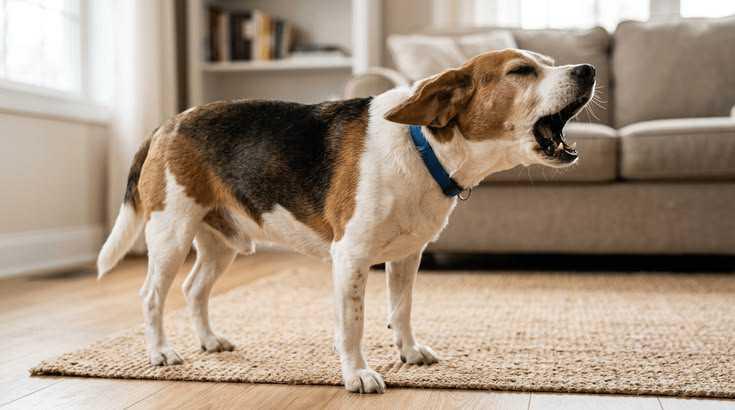
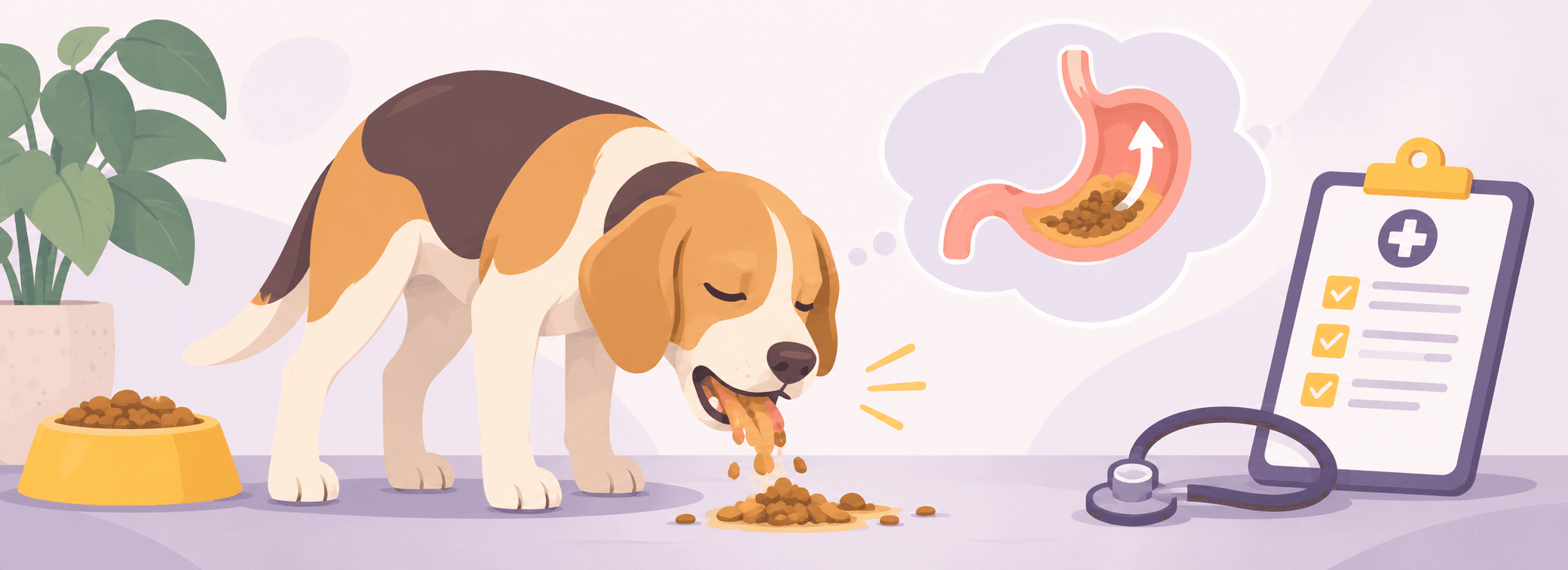
Coughing in dogs is a symptom, not a diagnosis. Most coughs come from airway irritation or infection such as kennel cough, but a cough can also signal tracheal collapse, pneumonia or heart disease. The quickest way to narrow it down is to notice whether the cough is dry or wet, when it happens, and what else has changed.
In puppies, infection is the most likely cause, so a coughing puppy deserves a lower threshold for a vet call. In older dogs, heart and chronic airway disease move higher on the list. A dry cough in dogs, the harsh and honking kind, usually starts in the throat or windpipe; a wet cough points deeper, toward the lungs.
Go to an emergency vet now if your dog has pale, gray or blue gums, labored breathing at rest, collapse, extreme lethargy, coughing up blood, or retching that brings nothing up while the belly swells. Otherwise, leave human cough and cold medicines out of it, and record a 10–15 second video of the cough for your vet.
Key Takeaways
- Coughing in dogs is a symptom of an underlying problem, ranging from mild upper-airway irritation such as kennel cough to heart or lung disease.
- Pale, gray or blue gums, labored breathing at rest, collapse, extreme lethargy, coughing up blood, or retching that brings nothing up while the belly swells means emergency veterinary care now.
- A body harness instead of a neck collar takes pressure off the windpipe and can ease a dry, honking cough.
- Never give a dog human cough or cold medicine. Common ingredients such as pseudoephedrine and xylitol can poison dogs.
A quick guide to coughing in dogs
Short answer: Most coughing in dogs comes from kennel cough, tracheal collapse, heart disease, pneumonia or an inhaled foreign object. Triage it by checking gums and breathing first, then noting the cough's sound and timing.
Sound and timing do most of the sorting. A honking cough set off by excitement or leash pressure points to the windpipe. A cough that ends in a gag usually means throat irritation. A soft cough that shows up at rest or overnight raises the question of heart disease, and a wet, phlegmy cough points to the lungs.
Is it an emergency? If any of the red flags above are present, yes. A dog who is bright, eating and drinking normally can usually be observed at home for up to 3 days. When an episode starts, film 10-15 seconds that capture the sound and your dog's chest movement.
- Check gums and breathing. Any red flag means emergency care now.
- Swap the neck collar for a harness.
- Skip human cough and cold medicine.
Common causes of dog coughing
Vets sort coughs by where they start: the upper airway (throat, larynx and windpipe), the lower airway and lungs, the heart, or a foreign object. Matching the sound, timing and trigger to those groups narrows the list quickly, which is why your vet will ask more about the cough than you might expect. Dog coughing and gagging together usually points to the upper airway, while a dry cough that lingers for weeks raises the question of chronic airway or heart disease.
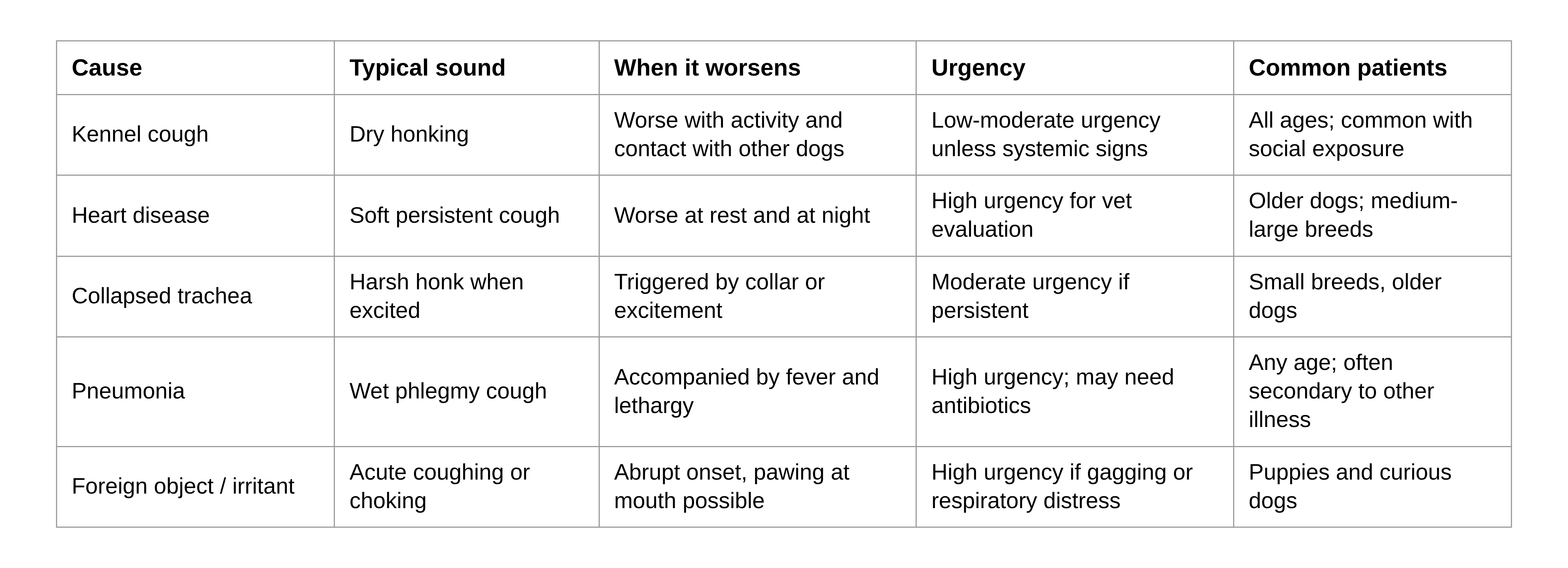
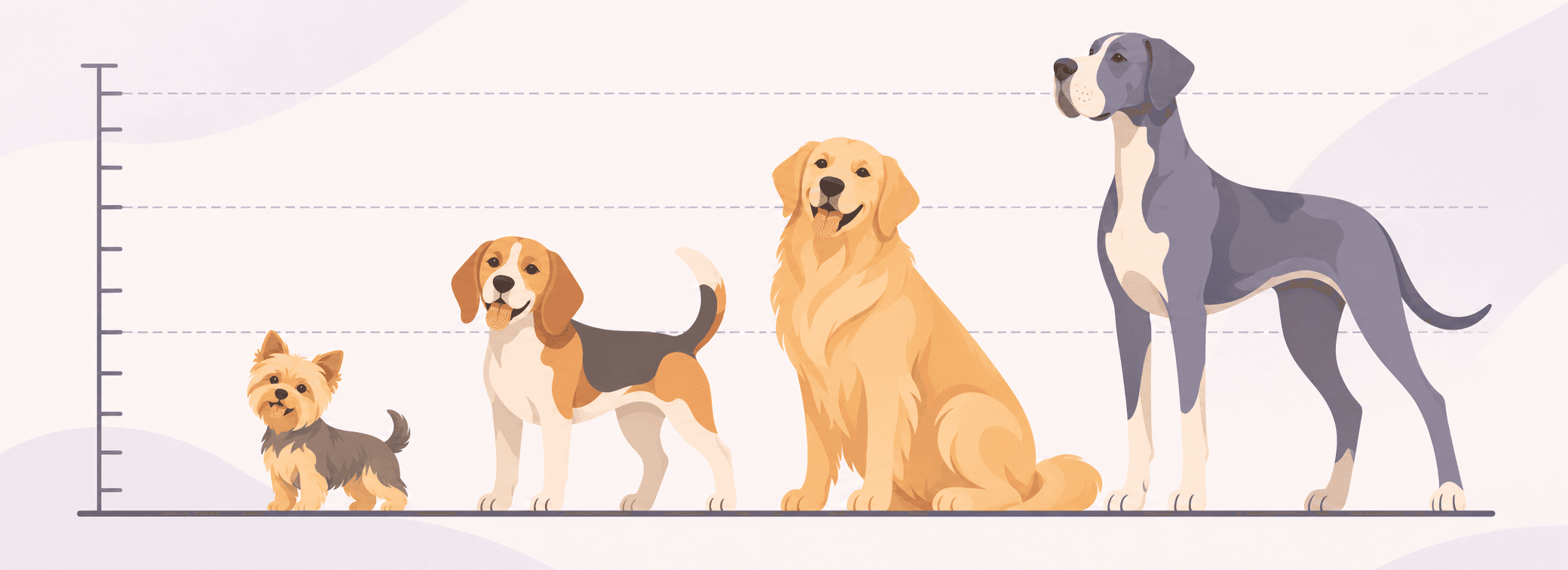
Age and breed shift the odds. Puppies under four months and unvaccinated dogs are at higher risk of distemper, which can bring fever, nasal discharge and coughing, according to the AVMA. Toy breeds are prone to tracheal collapse, Cavaliers to heart valve disease, and older Labradors to laryngeal paralysis.
The pattern matters as much as the cause. A cough that is new, changing, or arriving alongside other shifts (less interest in food, more drinking, lower energy) tells your vet more than a single dramatic episode.
Kennel cough
Kennel cough is the everyday name for canine infectious respiratory disease complex (CIRDC), a contagious airway infection caused by agents including Bordetella, parainfluenza, adenovirus and canine influenza. The Merck Veterinary Manual describes spasms of harsh, dry coughing that may end in retching and gagging.
- It spreads at daycare, boarding and dog parks and through shared water bowls, and VCA notes that dogs are contagious before signs appear.
- VCA reports that most cases resolve within 7 to 10 days with supportive care: rest, fresh water and a calm routine.
- Keep your dog away from other dogs while coughing and tell the clinic before you arrive. A cough that turns wet or comes with fever can mean a secondary infection.
Heart disease
An enlarging heart can press on the airways, and a failing heart can let fluid collect in the lungs (congestive heart failure). The cough tends to be soft and persistent, and many dog parents first notice it at rest or overnight. The University of Missouri veterinary cardiology service asks pet parents to call if the sleeping breathing rate stays above 35 breaths a minute, or climbs above the pet's own usual rate for three days in a row. Our guide to normal dog heart rate covers checking vital signs at home.
A known murmur and a predisposed breed such as the Cavalier King Charles spaniel point toward the heart. Still, the ACVIM consensus guidelines caution that airway disease is common in these dogs, so a murmur alone doesn't prove the cough is cardiac. Vets confirm it with chest X-rays, an echocardiogram and sometimes an NT-proBNP blood test.
Collapsed trachea
Tracheal collapse happens when the cartilage rings that hold the windpipe open weaken and flatten. The American College of Veterinary Surgeons notes it mostly affects small breeds such as Yorkshire terriers, Pomeranians, poodles and Chihuahuas, usually from middle age, with overweight dogs and dogs living with smokers at higher risk.
The cough is a harsh, dry honk, often set off by excitement, being picked up or a tug on the collar. A body harness removes that pressure from the throat.
Diagnosis uses chest X-rays, fluoroscopy (a moving X-ray) and sometimes a camera passed into the airway. ACVS reports that medical management, meaning weight loss plus medication to calm airway spasm and inflammation, may work for up to 70% of dogs; others may need rings or a stent to support the trachea.
Pneumonia and chest infections
Pneumonia is infection or inflammation of the lungs themselves, and it usually makes a dog look unwell rather than just noisy. It can follow kennel cough, or develop when food, water or vomit is inhaled (aspiration pneumonia).
- Clinical cues: a deep or wet cough, fever, lethargy, poor appetite, and labored breathing, according to the Merck Veterinary Manual. Our guide to fever in dogs explains what to look for.
- How vets tell it apart: chest X-rays and sometimes an airway wash to identify bacteria. A simple upper-airway infection usually leaves a dog alert, eating and fever-free.
- Treatment: antibiotics chosen by your vet, sometimes breathing treatments, and oxygen in hospital for dogs whose gums turn bluish.
Foreign objects and irritants
An inhaled foreign object usually announces itself suddenly: a dog that was fine on the trail starts sneezing, coughing or pawing at its face. Grass awns called foxtails are a common culprit; UC Davis sees most cases from spring into fall in Northern California, though they occur year-round. Unlike infections, these don't spread between dogs. Smoke, aerosol sprays, dust and seasonal allergies cause a different pattern: a cough that comes and goes with exposure. Finding a lodged object can take X-rays, ultrasound or a CT scan, and removal may need a scope or surgery.
- The cough or sneezing began suddenly, often during or after time outdoors.
- Your dog paws at the mouth or nose, or has discharge from one nostril.
- Signs persist or worsen instead of easing over a few days.
Why is my dog coughing and gagging?
Coughing and gagging often travel together. A dog with kennel cough may hack for several seconds and finish with a gag that brings up white foam, so it looks as if something is stuck in the throat. Tracheal collapse, laryngeal problems and lodged objects can do the same, because irritation in the throat and windpipe triggers both reflexes. In a coughing, gagging puppy, infection is the most common explanation, but a puppy that is also lethargic or off its food should see a vet promptly.
Next, notice what comes up. A productive gag brings up mucus or foam. Retching that brings nothing up needs more care: in a large, deep-chested dog with a swelling belly, it can signal bloat (gastric dilatation-volvulus), which the ACVS describes as life-threatening and needing immediate attention. Undigested food soon after a meal points toward the esophagus rather than the airway.
- Timing: before, during or after meals, drinking, exercise or sleep.
- What comes up: foam, mucus, food, bile or nothing at all.
- Other signs: belly size, drooling, appetite, energy and any change in your dog's bark.
How to tell a dry cough from a wet cough in dogs
A dry cough is harsh, hacking or honking and brings up little or nothing. A wet cough sounds softer and moist, sometimes gurgling, and may end with swallowing or bringing up mucus.
Dry coughs usually start in the upper airway: kennel cough, tracheal collapse, chronic bronchitis (a cough lasting at least two months, per Merck) or an irritant. In a dog that is eating and energetic, they usually allow time to observe. Wet coughs suggest fluid or mucus deeper in the lungs, from pneumonia or heart-related fluid, and deserve a faster appointment.
Some sounds fit neither. Reverse sneezing is a rapid, snorting inhale through the nose that VCA describes as harmless and lasting several seconds to a minute. When you aren't sure what you heard, a recording lets your vet hear it too.
- Start recording as soon as an episode begins and capture 10-15 seconds with the sound clearly audible.
- Film your dog side-on so chest and belly movement are visible, then briefly show the gums if your dog allows it.
- Note the time, what came just before (sleep, a walk, a drink, excitement) and how often episodes are happening.
When to call the vet for a coughing dog
Go to an emergency vet now if your coughing dog has pale, gray or blue gums, labored breathing at rest, collapse, extreme lethargy, coughing up blood, or retching that brings nothing up while the belly swells. For everything else, one rule applies: if the cough hasn't improved after 3 days, or gets worse at any point, book a vet visit within 24 hours.
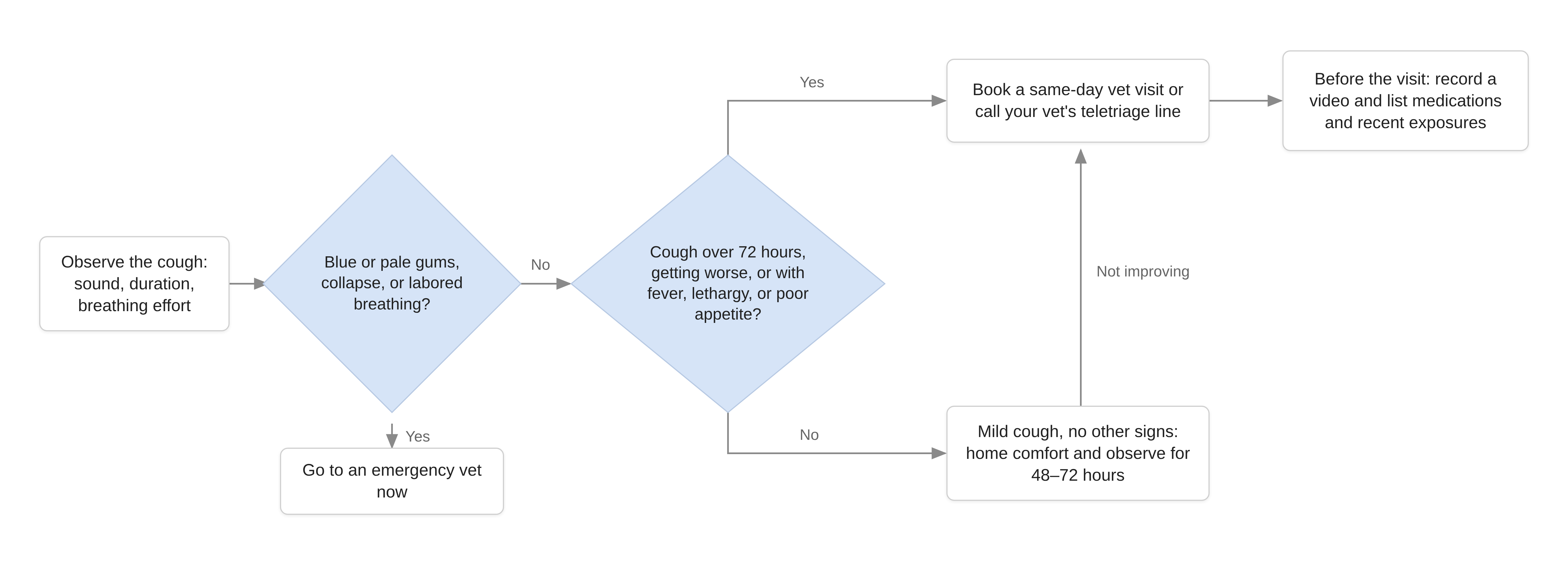
FLOWCHART CONTENT:
A["Observe the cough: sound, duration, breathing effort"] --> B{"Blue or pale gums, collapse, or labored breathing?"}
B -- Yes --> E["Go to an emergency vet now"]
B -- No --> C{"Cough over 72 hours, getting worse, or with fever, lethargy or poor appetite?"}
C -- Yes --> D["Book a same-day vet visit or call your vet's teletriage line"]
C -- No --> F["Mild cough, no other signs: home comfort and observe for 48–72 hours"]
F -- Not improving --> D
D --> G["Before the visit: record a video and list medications and recent exposures"]
Some dogs shouldn't wait the 3 days. Call your vet the day the cough starts for a puppy, a senior, a flat-faced breed or a dog with known heart disease, or if the cough comes with fever, poor appetite or faster breathing during sleep. Dogs are good at masking discomfort, so quieter changes count; our guide on how to tell if your dog is in pain covers the subtler signs.
Before the visit, gather your videos, when the cough started, any recent boarding, daycare, travel or hikes, vaccination history, and current medications or supplements.
Safe home care for a coughing dog
Home care is for a mild cough without red flags. It keeps your dog comfortable while you observe or wait for an appointment; it does not replace a diagnosis.
- Swap the collar for a harness. Walk gently, with no leash pressure on the throat.
- Add humidity. Run a humidifier near your dog's bed, or sit together in a steamy bathroom for 10–15 minutes, never leaving your dog alone.
- Keep water fresh and close. Offer it often; tacky gums and low energy can signal dehydration.
- Keep things calm. Limit exercise and excitement, which can set off coughing fits.
- Record and escalate. Film episodes, note their timing, and call your vet if a red flag appears or the cough hasn't improved after 3 days.
Don't give human cough or cold medicine. The ASPCA warns that these products often combine ingredients such as pseudoephedrine, acetaminophen and dextromethorphan, and flags xylitol in cough drops as a particular concern. If your dog has already swallowed one, call your vet or ASPCA Animal Poison Control at (888) 426-4435. Skip herbal remedies unless your vet approves them, and keep smoke, scented candles and aerosol sprays away from your dog.
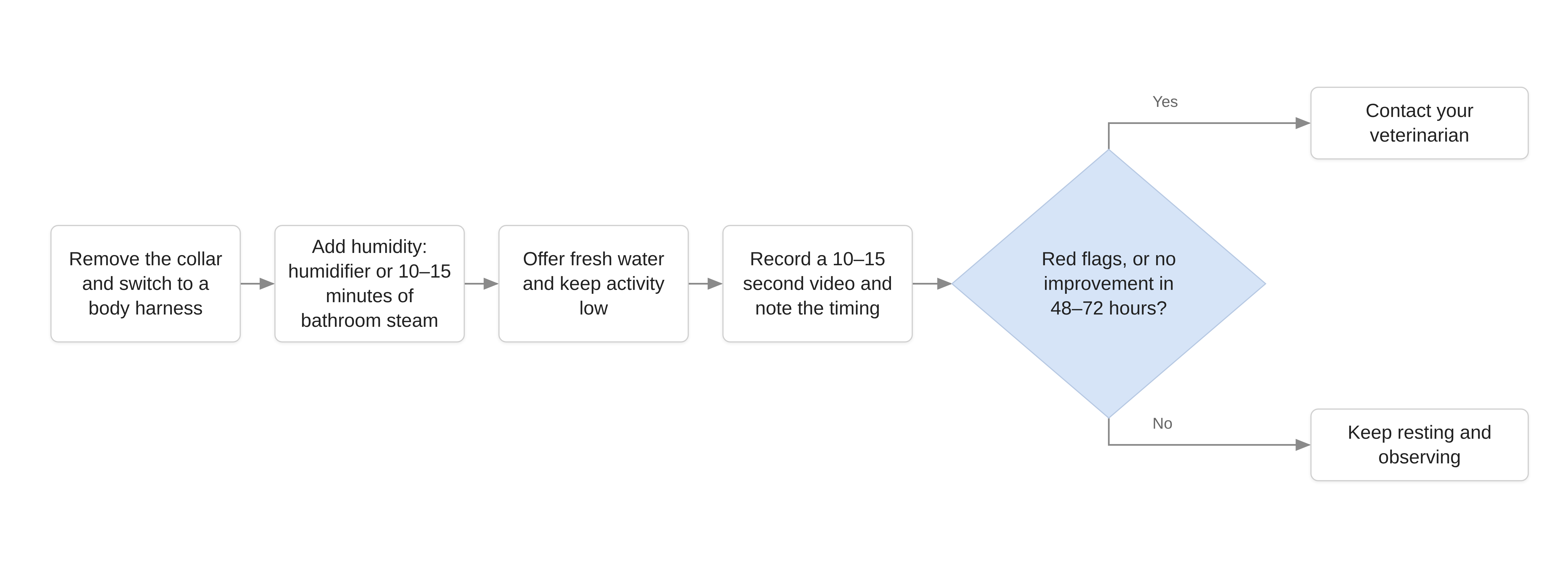
FLOWCHART Content:
A["Remove the collar and switch to a body harness"] --> B["Add humidity: humidifier or 10–15 minutes of bathroom steam"]
B --> C["Offer fresh water and keep activity low"]
C --> D["Record a 10–15 second video and note the timing"]
D --> E{"Red flags, or no improvement in 48–72 hours?"}
E -- Yes --> F["Contact your veterinarian"]
E -- No --> G["Keep resting and observing"]
How eating and drinking records can add context
A cough rarely changes on its own. Appetite and drinking often shift around it, and those are the details dog parents find hardest to recall with confidence in the exam room. Was she drinking more before the cough started, or after? Did he skip one breakfast or three?
EverBowl™ from Hoomanely learns your dog's everyday eating and drinking patterns relative to their own baseline and picks up changes that persist over several days. It does not hear coughs or diagnose their cause. The value is the record: a clearer history of eating and drinking changes to discuss with your veterinarian. A red flag always means going straight to care.
Conclusion
Most coughing in dogs is manageable once the cause is clear, and many cases settle with rest and supportive care. A dry, honking cough usually involves the throat and windpipe, while a wet cough points to the lungs and deserves quicker attention. Any red flag means an emergency vet now. Otherwise, record the cough, keep human medicines out of it, and book a visit if it hasn't improved after 3 days. A clear account of what changed and when is one of the most useful things you can bring to the exam room.
FAQs
1.Why is my dog coughing like something is stuck in his throat randomly
This type of sudden hacking or honking often points to an upper respiratory infection like kennel cough or a collapsing trachea. If your dog is also pawing at their mouth, frantic, or struggling to swallow, it could mean a physical object is trapped, requiring immediate veterinary assessment.
2.What does a dog heart failure cough sound like
A cardiac cough typically sounds soft, persistent, and muffled rather than loud or harsh. It frequently worsens at night or while the dog is resting due to fluid accumulation around the lungs caused by an enlarged heart.
3.Can a puppy get a cough from environmental irritants
Yes, puppies have highly sensitive airways that can easily be inflamed by household cleaning sprays, heavy dust, pollen, or secondhand smoke. Removing the source of irritation and placing the puppy in a humidified room can help soothe their respiratory lining.
4.What should I do if my dog has a mild cough that lasts over three days
If a mild cough shows no signs of improvement within forty-eight to seventy-two hours, you should schedule a diagnostic appointment with your veterinarian. Any onset of fever, heavy phlegm, or breathing changes during this window requires rapid escalation.