Food Allergies in Dogs: Symptoms, Common Triggers & What to Do
Food allergies in dogs can cause persistent itching, recurrent ear or skin infections, vomiting, diarrhea, and other digestive changes. Because those signs overlap with environmental allergy, flea allergy, parasites, and food intolerance, symptoms alone cannot confirm the cause. The diagnostic standard is a strict 8–12-week elimination diet followed by a controlled food challenge.
The Short Version
- Food allergy and food sensitivity are not the same condition, although their symptoms can overlap.
- The reference standard for diagnosis is a strict 8–12-week elimination diet followed by a controlled food challenge. Improvement on a new diet alone does not prove food allergy.
- Beef, dairy, chicken, wheat, and lamb are among the most frequently reported food allergens in dogs. Grain-free food is not automatically an allergy treatment.
- Recurrent itching, paw licking, ear infections, vomiting, or diarrhoea deserve veterinary assessment, especially when the signs persist year-round or keep returning.
Food Allergies in Dogs: Quick Answer
Food-related reactions can affect the skin, ears, or gastrointestinal tract, and the outward signs often overlap with other conditions. Symptoms alone cannot confirm food allergy, so diagnosis depends on a veterinary-supervised elimination diet followed by a controlled food challenge.
Common signs: itching of the paws, ears, face, groin or armpits, recurrent ear or skin infections, vomiting, diarrhea, soft stools, flatulence, and sometimes weight loss.
Diagnostic path: veterinary assessment → strict 8–12-week elimination diet → controlled food challenge.
Changes in appetite, energy, grooming, or social behavior can also sit alongside physical symptoms. Hoomanely's guide to behavioral changes as health indicators explains why those accompanying changes are worth recording.
What Causes Food Sensitivity in Dogs?
The immune system recognizes a dietary component as a threat and reacts when the dog encounters it again. VCA notes that food allergies commonly develop after prolonged exposure to an ingredient rather than necessarily appearing the first time it is eaten.
A non-immune food sensitivity is different. A food's fat level, fiber content, digestibility, or another characteristic may cause gastrointestinal problems without an allergic immune reaction. This distinction matters because a dog with loose stool after a food change does not automatically have a food allergy.
Frequently reported allergens include:
- beef
- dairy products
- chicken
- wheat
- lamb
- eggs
- soy
A review of the available canine food-challenge evidence found beef, dairy, chicken, wheat, and lamb among the most frequently reported triggers. The authors also cautioned that these figures partly reflect which foods dogs commonly ate and which ingredients researchers chose to challenge. They should not be interpreted as a prediction of what any individual dog will react to.
Grains therefore should not be treated as the default culprit. Wheat can cause reactions in some dogs, but animal-derived proteins feature prominently among confirmed triggers.
A food allergy is different from food poisoning. Foods such as chocolate, grapes and raisins, onions, garlic, and products containing xylitol can be toxic to dogs rather than allergenic. The ASPCA advises contacting a veterinarian or the ASPCA Animal Poison Control Center at (888) 426-4435 if a toxic-food ingestion is suspected. Do not wait for itching, vomiting, or other symptoms to appear.
Symptoms of Food Allergies and Sensitivities in Dogs
Food-related reactions commonly affect the skin, ears, or gastrointestinal tract. The pattern can be more informative than any single symptom.
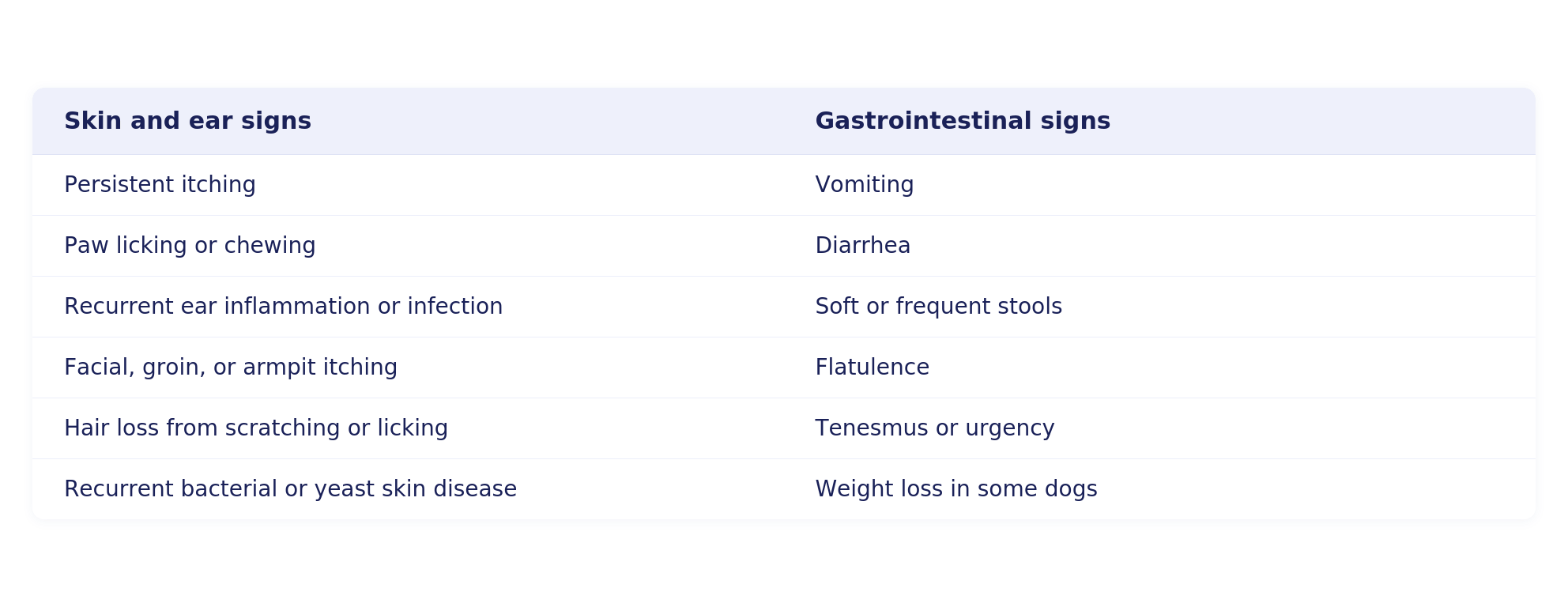
Merck notes that food-allergic dogs may have both cutaneous and gastrointestinal signs. Relapsing otitis externa and secondary bacterial or yeast infections are also common because chronic scratching and inflammation disrupt the skin barrier.
Food allergy can appear in young dogs as well as adults. NC State notes that signs often begin before one year of age, although they can first appear later depending on dietary history. Symptoms of food allergies in puppies are not specific enough to diagnose allergy, however. Vomiting, diarrhea, itching, or poor growth in a puppy can have many other causes and warrants veterinary assessment rather than an immediate food switch.
Parasites are another common source of itching and skin damage. A consistent parasite prevention plan helps remove one major competing explanation during an allergy workup.
A severe allergic reaction in dogs, with facial swelling, widespread hives, collapse, or difficulty breathing, is a different situation. Severe allergic reactions require emergency veterinary care rather than a home elimination trial.
How Veterinarians Diagnose Food Allergies in Dogs
The diagnostic standard is a strict 8–12-week elimination diet followed by a controlled food challenge.
Bloodwork, examination, skin testing, parasite checks, ear cytology, and other diagnostics may still be needed to investigate competing causes. But no routine blood, saliva, hair, or skin test can independently establish that a particular food is causing the dog's clinical signs. Merck notes that these methods have not produced consistently reliable correlation with true clinical food reactions.
The difficult part of an elimination trial is often not choosing the food. It is controlling everything else the dog eats.
How to Run an Elimination Diet Trial
Work with your veterinarian to select either a veterinary hydrolyzed diet or an appropriate novel-protein diet.
Pay attention to a strict 8–12-week elimination diet followed by a controlled food challenge. VCA's guidance specifically excludes treats, supplements, flavored vitamins, and certain flavored parasite preventives during the trial.
That means checking:
- treats and table scraps
- flavored medications and supplements
- pill pockets
- edible chews and rawhides
- flavored dental products
- food stolen from another pet's bowl
- food used to hide medication
In a two-dog household, one bite from the other dog's bowl can turn a carefully controlled trial into an unclear result.
If symptoms improve, the trial is not finished. The original food or selected ingredients are reintroduced under veterinary guidance. Merck notes that clinical signs may return within hours or days, but a positive challenge can take up to 10–14 days to appear. A food allergy is confirmed when symptoms improve during elimination and recur after challenge.
Why Blood and Skin Tests Have Limits
Commercial serum IgE, saliva, intradermal, and hair tests have all been studied for food allergy. Merck concludes that none can reliably prove or rule out a clinical food allergy on its own.
Some specialist tests may help a veterinary dermatologist choose ingredients for an elimination diet, but they remain adjuncts. They do not replace elimination and rechallenge.
Diet and Treatment Options for Food-Sensitive Dogs
Once an offending ingredient is confirmed, treatment centers on avoiding it while keeping the overall diet complete and balanced.
The best food depends on the dog's previous diet, nutritional needs, age, medical history, and how strictly cross-contact needs to be controlled.
Hydrolyzed vs. Novel Protein Diets
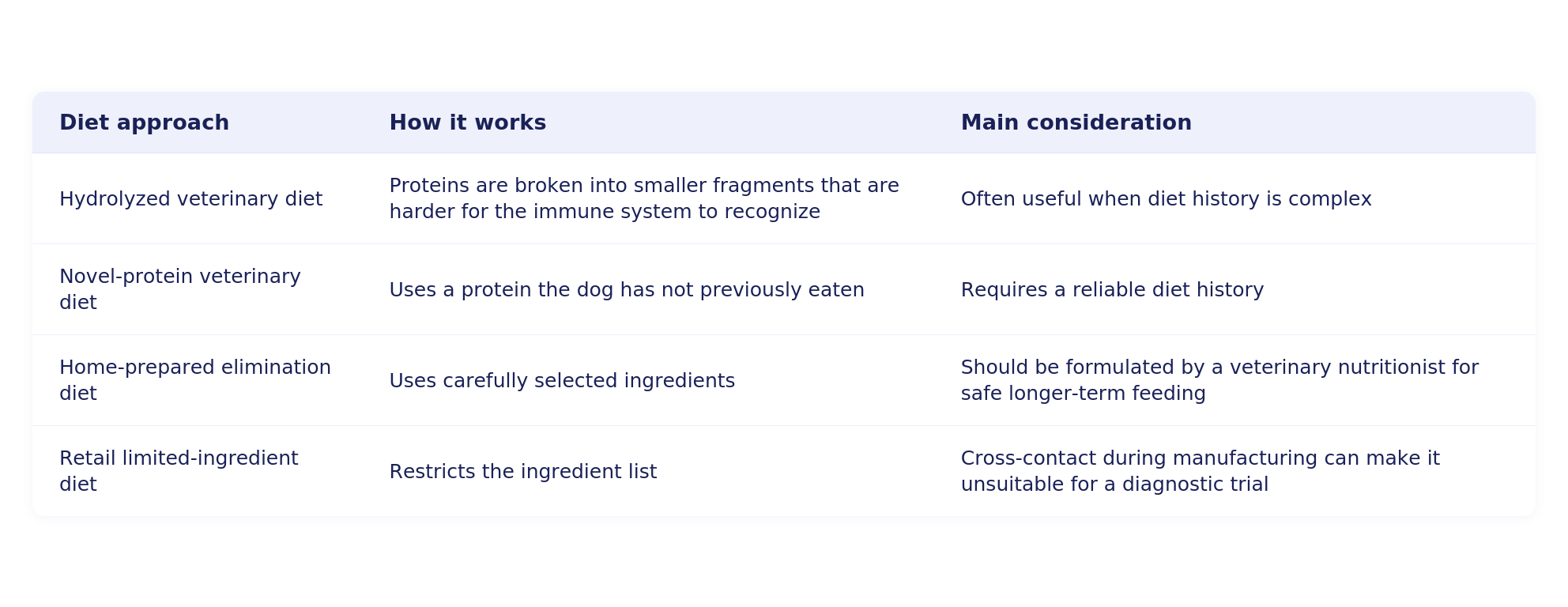
Hydrolyzed diets reduce the size of protein fragments to make immune recognition less likely. Merck notes that more extensively hydrolyzed diets are less likely to produce clinically meaningful reactions, although no approach guarantees zero reaction in every sensitized dog.
Novel-protein diets use ingredients the dog has not previously eaten. That sounds simple until a diet history includes chicken kibble, beef treats, salmon chews, flavored medications, and several years of rotating foods. Merck also notes possible cross-reactivity between related and even some seemingly unrelated proteins, although the clinical importance is not always clear.
Over-the-counter vs. Prescription Options
A retail food labeled “limited ingredient” may be perfectly suitable for some dogs after diagnosis, but it is not necessarily equivalent to a veterinary elimination diet.
Both VCA and NC State warn that over-the-counter foods can be exposed to other proteins during manufacturing. For a diagnostic trial, unintended cross-contact can make the result difficult to interpret.
Prescription does not mean a food is automatically better for every dog. It means the veterinarian can select a diet with manufacturing controls and nutritional characteristics appropriate to the diagnostic question.
Medications and Supplements That Support Recovery
Diet identifies and removes the trigger. Medication may still be needed to control the consequences.
Merck notes that dogs with food allergy may require antipruritic treatment during a diet trial, while bacterial or yeast infections should be treated when present. AAHA's allergic skin disease guidelines likewise support targeted antipruritic therapy as part of managing canine allergic skin disease while the underlying trigger is being addressed.
Your veterinarian may use:
- prescription anti-itch therapy when scratching is severe
- antimicrobial treatment for confirmed secondary infection
- medicated ear or skin therapy when indicated
- targeted nutritional support where the dog's full diet and condition justify it
Supplements should not be added casually during an elimination trial. A flavored chew or animal-derived capsule can introduce a protein that undermines the trial. Discuss every supplement with the veterinarian running the diet.
How to Prevent and Manage Food Sensitivities in Dogs
There is no proven feeding trick that prevents food allergy or food sensitivity in dogs.
Rotating proteins is sometimes promoted as prevention, but repeatedly exposing a dog to many proteins can make it harder to find a genuinely novel ingredient if an elimination trial is needed later. A gradual food transition can reduce digestive upset when changing diets, but it should not be presented as a way to prevent an immune-mediated allergy.
For a dog with a confirmed trigger, management is much more concrete:
- avoid the confirmed ingredient consistently
- check treats, chews, supplements, and flavored medications
- use a complete and balanced long-term diet
- treat recurrent ear or skin infections promptly
- keep flea and parasite control current
- record diet changes and symptom flares
- bring a full food and medication history to veterinary visits
Merck specifically recommends keeping a diary during an elimination trial because dates, symptom severity, travel, visitors, and accidental dietary exposures can make partial improvement easier to interpret.
If your dog suddenly seems different beyond the skin or stomach signs, Hoomanely's guide to recognizing when a dog feels off can help organize the other changes worth mentioning to your veterinarian.
What an Eating and Drinking Baseline Can Add
A diet trial creates a lot of details to remember. Maybe breakfast was finished Monday, half eaten Tuesday, and barely touched Wednesday. At the same time, the owner is watching stool quality, itching, ears, medications, and accidental exposures.
Hoomanely EverBowl™ learns a dog's normal eating and drinking patterns and recognizes when those patterns move away from the established baseline. During a veterinary-supervised diet change, that longitudinal record can add context about whether intake changed as the diet or symptoms changed.
EverBowl does not diagnose a food allergy, identify the offending ingredient, or replace an elimination-challenge trial. The value is the record: giving the veterinarian a clearer timeline of eating and drinking changes alongside the owner's notes on itching, stools, ear problems, and dietary exposures.
Conclusion
Food allergies in dogs cannot be diagnosed from itching, vomiting, or a food label alone. The reliable route is a strict 8–12-week elimination diet followed by a controlled food challenge.
If food allergy is confirmed, long-term management is based on avoiding the trigger while feeding a nutritionally complete diet and treating any secondary skin or ear disease. Before removing grains, changing proteins repeatedly, or buying an allergy test, bring your veterinarian a complete history of everything your dog eats. That history is where a useful diet trial starts.
FAQs
1. Can I Give My Dog Benadryl for Food Allergies?
Diphenhydramine (Benadryl) is an antihistamine veterinarians sometimes use for an allergic reaction in dogs, but it does not identify or remove a dietary trigger.
2.What are the Three Most Common Food Allergens for Dogs?
Beef, dairy, and chicken were the three most frequently reported allergens in a critically appraised review of dogs with confirmed adverse food reactions, followed by wheat and lamb. The authors cautioned that the rankings reflect historical feeding patterns and available challenge data rather than the probability that an individual dog will react to a particular food.
3.Can Food Allergies Cause Sudden Hair Loss?
Food allergy can contribute to hair loss, usually because persistent itching, licking, inflammation, or secondary infection damages the coat and skin. Merck lists alopecia among the cutaneous signs associated with food allergy. Sudden or extensive hair loss still deserves veterinary assessment because endocrine disease, parasites, infection, and other skin conditions can look similar.
4.Is Zyrtec Safe to Use for Canine Allergy Symptoms?
Cetirizine (Zyrtec) is used by veterinarians in some dogs with allergic itch, but it should not be treated as a diagnostic or primary treatment for food allergy. Ask your veterinarian before using a human formulation, particularly because combination products may contain additional active ingredients. Removing a confirmed dietary trigger remains the basis of food-allergy management.
5.Does a Grain-Free Diet Cure Food Sensitivities?
No. Grain-free food does not automatically remove the ingredient causing a reaction. Beef, dairy, chicken, wheat, and lamb are among the reported canine food allergens, and animal proteins account for several of the most commonly identified triggers. A diet should be chosen according to the dog's history and elimination-trial plan, not the presence or absence of the word “grain.”
6.Why Does My Dog Keep Getting Ear Infections from Food?
Food allergy can contribute to recurrent inflammation of the ear canal, which can make secondary yeast or bacterial infection more likely. Merck lists relapsing otitis externa among the characteristic cutaneous manifestations of food allergy. Repeated ear infections still need examination because environmental allergy, ear anatomy, moisture, parasites, and other conditions can produce the same pattern.