How Much Should I Feed My Dog? Daily Feeding Guide by Age, Weight & Breed
How much should I feed my dog? There is no single cup amount that works across dogs. Daily portions come from ideal body weight, a daily calorie target, and the calorie density of the food. Using AAHA's formula as a starting estimate, a healthy 40 lb neutered adult calculates to roughly 862–985 kcal per day, but actual needs vary by body condition, activity, health, and the individual dog.
For most healthy adult dogs, divide the daily calorie allowance into at least two meals. VCA and AKC feeding guidance generally supports about four meals daily for young puppies, moving toward three meals around three months and often two meals later in puppyhood, with timing adjusted for breed size, health, and growth rate.
The Short Version
- Most adult dogs should eat at least two scheduled meals per day. Some dogs need a different schedule because of age, medical conditions, work demands, or appetite.
- Young puppies commonly start with about four measured meals per day, move toward three meals around three months, and often reach two meals per day later in puppyhood.
- Daily portions depend on calorie requirements, not cups alone. Two foods can provide very different calories in the same volume, and calculated needs are starting estimates to reassess against body weight and body condition.
- AAHA recommends that at least 90% of a dog's daily calories come from a complete and balanced diet, with treats and other foods limited to no more than 10%.
How Many Times a Day Should a Dog Eat?
Most healthy adult dogs do well with at least two meals per day. VCA notes that an empty stomach begins generating hunger signals after roughly 8 to 10 hours, which is one reason twice-daily feeding works well for many dogs.
Regular meal times also make appetite changes easier to recognize. They can simplify house-training, medication schedules, and monitoring in dogs with medical conditions.
The schedule may need to change for dogs that tolerate only small meals, working dogs with high energy demands, dogs with gastroesophageal reflux disease, or dogs receiving medication with food. Toy-breed puppies can require particularly frequent meals because juvenile hypoglycemia is a recognized risk during the first months of life.
How Much Food Should My Dog Eat?
Start with three pieces of information:
- Ideal body weight: Use the weight your veterinarian considers healthy, especially if your dog is currently underweight or overweight.
- Daily calorie target: Use the food label as a starting point or ask your veterinary team to calculate an energy requirement.
- Calories in the food: Check the kcal per cup, can, pouch, or gram and convert the daily calorie target into an actual portion.
AAHA’s 2021 Nutrition and Weight Management Guidelines use resting energy requirement, or RER, as the starting point for calorie estimation:
RER = 70 × body weight in kilograms^0.75
AAHA then applies life-stage factors to that starting estimate. For neutered adult dogs, its guidance uses approximately 1.4–1.6 × RER, with the result adjusted according to body weight, body condition, activity, and the individual dog's response.
Why Calorie Density Changes the Portion
Consider an illustrative dog with a starting calorie estimate of about 860 kcal per day.
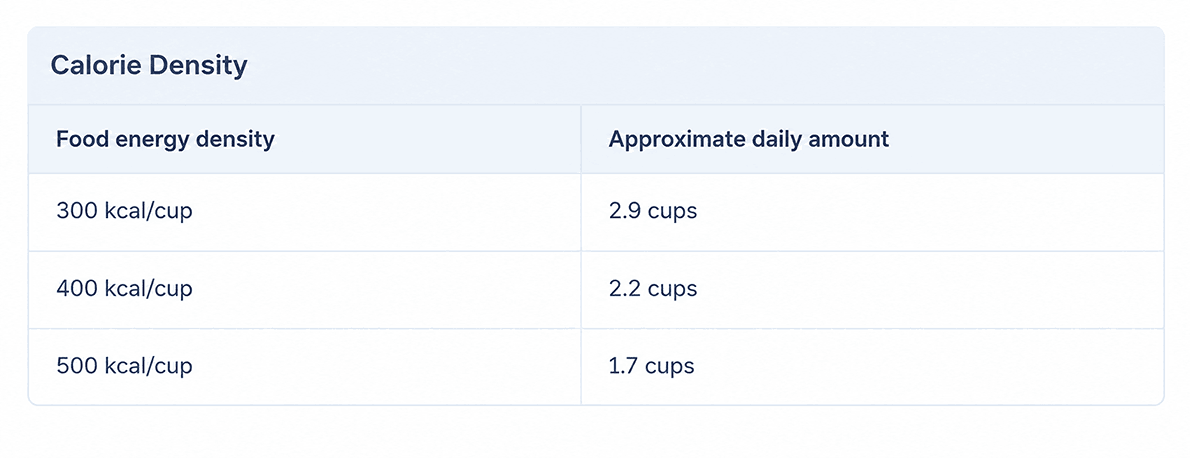
The example calorie target is unchanged. The amount in the bowl changes considerably with calorie density.
Adult Dog Feeding Chart
The table below applies AAHA's 1.4–1.6 × RER estimate to example healthy neutered adults and assumes a dry food containing 400 kcal per cup. These are starting estimates for illustration, not individualized feeding prescriptions.
Ideal adult weight | Example calories/day | At 400 kcal/cup
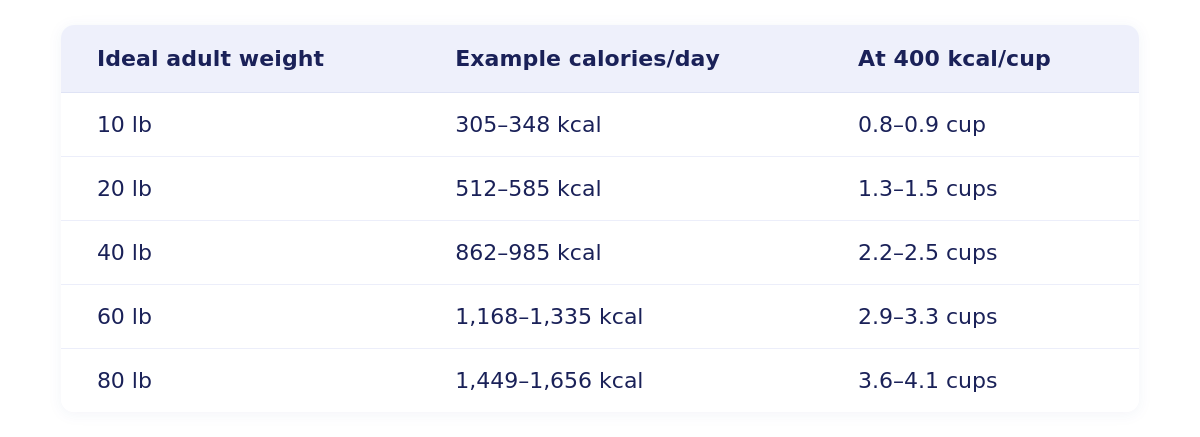
Use the dog's ideal weight, then adjust according to body condition, activity, and veterinary guidance.
Puppy Feeding Chart
How much should I feed my puppy? Growing puppies require more energy relative to body size than adults, so the multipliers are higher. AAHA uses approximately 3 × RER for puppies younger than four months and 2 × RER from four months onward as general starting calorie estimates, not fixed feeding prescriptions.
Meal frequency and calorie requirements do not change on the same timetable. A puppy may move from four to three meals around three months while still using the younger-puppy calorie estimate until about four months.
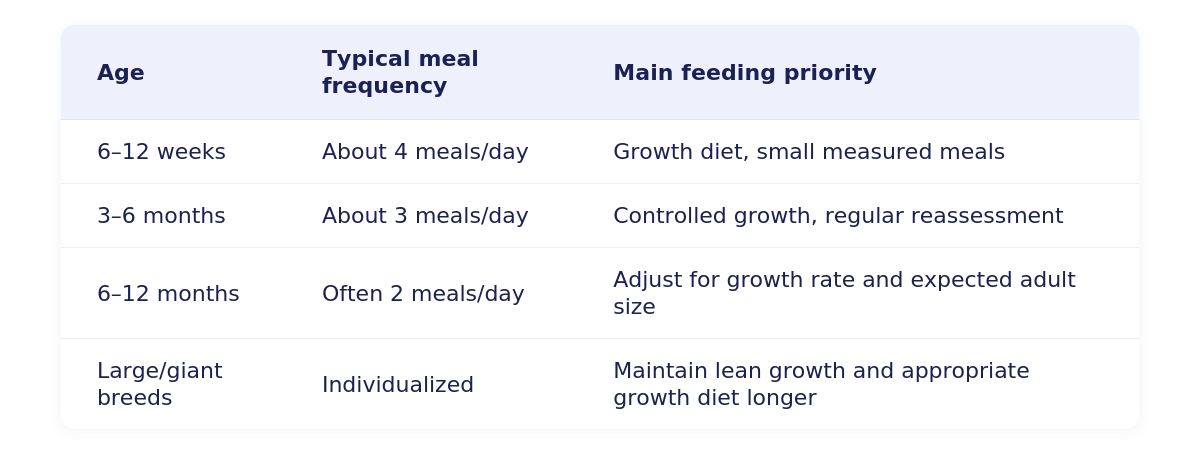
Large and giant puppies need particular care. Excess calories can accelerate growth and increase orthopedic risk. Large and giant breeds mature later than smaller dogs. AAHA notes that skeletal maturity in some large and giant dogs may extend to about 15–16 months. The age at which a growth diet is discontinued is a separate feeding decision. VCA notes that some large breeds may remain on an appropriate growth diet until around 18 months, while giant breeds may continue until as late as 24 months.
Feeding Senior Dogs
Age alone does not provide a reliable cup reduction. AAHA notes that AAFCO does not set separate nutritional requirements for mature, senior, or geriatric dogs, so age alone does not determine whether a dog needs a different diet. Some older dogs become less active and need fewer calories. Others lose weight or muscle because of illness and may need a different nutrition plan.
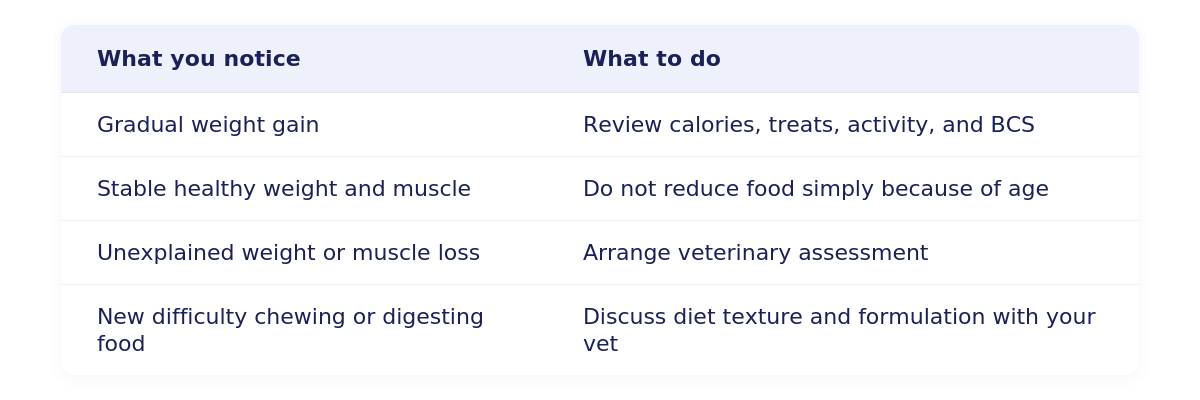
A “senior” label on a food does not determine how much your dog should eat. Body condition, muscle condition, health status, and calorie density do.
How Many Times a Day Should a Puppy Eat?
AKC guidance supports frequent measured meals for young puppies. A practical puppy feeding schedule starts at about four meals daily at 6–12 weeks, moves toward three meals around three months, and commonly reaches two meals as the puppy matures.
Measured meals are preferable to unrestricted free feeding for most puppies. VCA notes that free-choice feeding can encourage excessive intake and makes controlled growth harder to maintain.
These meal-frequency ranges reflect general veterinary feeding guidance from VCA and AKC and should be adjusted for breed size, health, growth rate, and veterinary advice.
Puppies 6-12 weeks
Most recently weaned puppies do well with four small meals spread through the waking day.
An example schedule might be:
7:00 a.m. → 11:00 a.m. → 3:00 p.m. → 7:00 p.m.
The total daily calories do not increase because there are more meals. The daily allowance is divided across them.
Puppies 3-6 months
VCA notes that many puppies can transition to about three meals per day around three months.
Reassess the amount as the puppy grows rather than automatically adding food every week. Large-breed puppies should remain lean during growth; excessive feeding can accelerate skeletal development without increasing their eventual adult size.
Puppies 6-12 months
General veterinary feeding guidance places many puppies on a transition toward two daily meals during this period, although breed size, health, and growth rate can shift the timing.
The transition to adult food should follow skeletal maturity rather than an arbitrary first birthday. AAHA notes that small and medium dogs commonly remain on growth diets until about one year, while some large and giant breeds mature later.
After One Year
For many small and medium dogs, two measured meals are already the long-term routine by around one year. Large and giant breeds may still be growing and may remain on an appropriate growth diet longer.
Reassess the feeding plan when:
- weight changes without intention
- ribs become difficult to feel
- the waist disappears
- muscle mass declines
- activity changes significantly
- appetite changes persist
- a medical condition is diagnosed
Daily Feeding Guide by Age, Weight, and Breed
A reliable feeding guide for dogs follows the same sequence:
Ideal weight → calorie estimate → food calorie density → daily portion → number of meals → reassessment.
Breed can influence expected adult size, growth rate, activity, energy expenditure, and susceptibility to weight gain, but it does not determine a fixed portion by itself. Ohio State notes that individual calorie requirements can vary by as much as 50% from calculated estimates, including variation related to breed and lifestyle.
That is why a 40-pound highly active dog and a sedentary 40-pound dog should not automatically receive identical portions.
Use body condition as the feedback loop. The WSAVA nutrition toolkit includes a 9-point body condition scoring system, and veterinary guidance commonly targets a lean, healthy condition rather than feeding strictly to a number on the scale. On the WSAVA 9-point body condition scale, a score of 4–5/9 generally represents an ideal body condition, with ribs easily felt under a light fat covering and a visible waist.
Portion Sizing and Measuring Tips
A kitchen scale gives a more repeatable portion than estimating a scoop by eye. VCA specifically recommends weighing puppy food in grams where practical, and the same principle works for adult dry food.
Check the label for kcal per cup, can, or kilogram. Then account for everything else your dog receives during the day.
AAHA recommends that at least 90% of daily calories come from the complete and balanced primary diet, leaving no more than 10% for treats and other foods.
For a dog eating 600 kcal/day, that means treats should generally contribute no more than about 60 kcal.
If your dog gains weight, do not automatically cut food by an arbitrary percentage. Recheck portion accuracy, treats, calorie density, body condition, and activity first. Unexpected weight loss deserves veterinary assessment rather than simply adding food.
What Meal Data Can Add to a Feeding Plan
A feeding plan is easier to assess when you know what was actually eaten. Scheduled portions give you a reference point. Changes in appetite then become easier to describe.
EverBowl™ learns a dog's normal eating and drinking patterns over time. That record can provide context when appetite or intake changes and can sit alongside weight, body condition, stool, medications, and other observations when you speak with your veterinarian.
EverBowl does not decide how many calories your dog needs, diagnose a nutritional condition, or replace a veterinary nutrition plan. The calorie calculation still begins with the dog, the food, and an appropriate body-condition target.
For useful feeding records, note:
- what food was offered
- amount offered
- whether the meal was finished
- treats and toppers
- weekly body weight during puppy growth
- body condition over time
- vomiting, diarrhea, or persistent appetite changes
Conclusion
How much food should my dog eat? Start with ideal weight, life stage, activity, and the calorie density of the food. Package directions are a starting point. Body weight and body condition show whether the portion is appropriate.
How many times a day should a dog eat? At least twice, for most healthy adults. Young puppies need smaller meals more frequently, and large-breed growth requires tighter control of calories and body condition. Measure what goes into the bowl, keep treats within the daily calorie budget, and involve your veterinarian when weight, appetite, growth, or health changes unexpectedly.
FAQs
1. Is it better to feed a dog once or twice a day?
For most dogs, at least two meals per day is preferred. VCA recommends twice-daily feeding for many adult dogs, although some individuals need more frequent meals because of medical conditions or other factors.
2. What is the 3-3-3 rule for rescue dogs?
The 3-3-3 rule is a behavioral adjustment guideline, not a feeding formula. It is commonly used to describe the first three days, three weeks, and three months after adoption. A rescue dog's food amount should still be based on nutritional needs, current and ideal body condition, and veterinary advice rather than this rule.
3. Can 6-week-old puppies go all night without eating?
A 6-week-old puppy's feeding schedule should be individualized rather than based on a universal overnight fasting rule. VCA's general feeding guidance supports about four daily meals for many recently weaned puppies, but the schedule should be individualized for breed size, health, and hypoglycemia risk. Ask your veterinarian before extending overnight fasting in a very small or medically vulnerable puppy.
4. Is it okay to feed a puppy table scraps?
Table scraps should not replace or dilute a complete and balanced growth diet. If treats are used, count them within the puppy's total daily calories and keep extras limited. Your veterinarian can advise how much is appropriate for the puppy's age, size, and growth rate.
5. How do you correctly factor treats into a dog's daily food intake?
Count treat calories as part of the dog's total daily calorie allowance, not as extras added on top. If the dog needs 500 kcal/day, no more than about 50 kcal should generally come from treats and other incomplete foods, leaving roughly 450 kcal for the complete and balanced diet.