Why Is My Dog Snoring? Common Causes & When to Be Concerned
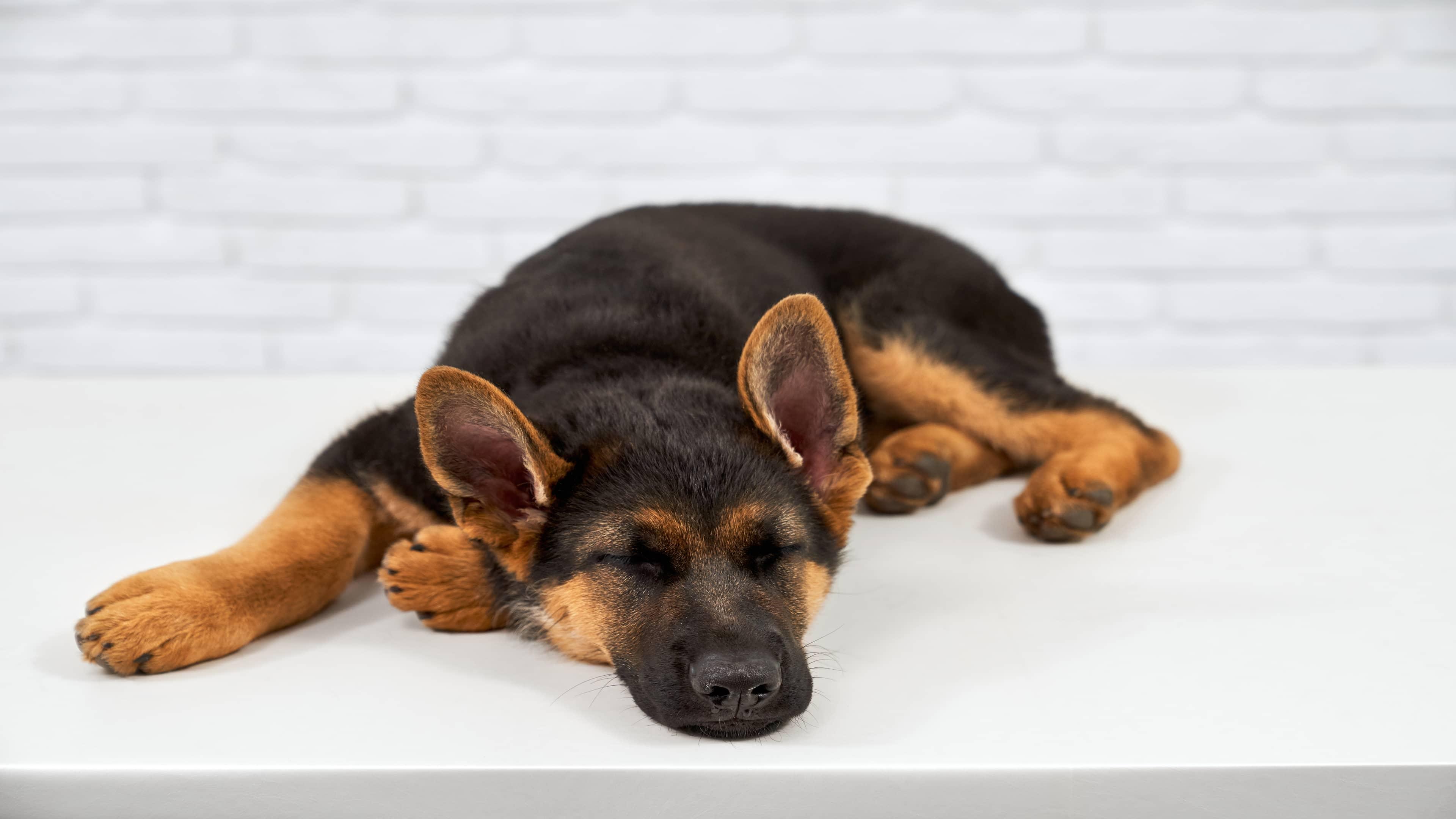
A dog may snore simply because of sleeping position or the natural shape of the upper airway. Snoring deserves more attention when it is new, getting louder, happens alongside noisy breathing while awake, or appears with coughing, gagging, nasal discharge, exercise intolerance, or labored breathing. Breathing difficulty, blue or gray gums, or collapse is an emergency. VCA recommends veterinary assessment when a dog develops a new recurrent snore or snoring appears with other respiratory signs.
When a dog is snoring, airflow is making tissues in the nose or throat vibrate. Sometimes the reason is harmless. In other dogs, narrowed nostrils, an elongated soft palate, inflammation, infection, excess body weight, a nasal foreign object, or an airway mass is reducing the space available for air to move.
The Short Version
- Occasional snoring can be normal, particularly when it changes with sleeping position and the dog breathes comfortably while awake.
- Flat-faced dogs are more likely to snore, but lifelong snoring should not automatically be dismissed as normal. Brachycephalic obstructive airway syndrome, or BOAS, can cause snoring, snorting, exercise intolerance, labored breathing, blue gums, and collapse.
- New or consistently worsening snoring deserves veterinary assessment, especially with nasal discharge, sneezing, coughing, gagging, wheezing, or reduced tolerance for exercise or heat.
- Breathing difficulty, blue or gray gums, collapse, or an apparent respiratory crisis requires emergency veterinary care.
Why Do Dogs Snore?
Snoring is usually an upper-airway sound. Air moving through a narrowed nose or throat causes soft tissues or fluid to vibrate. Veterinarians may call the low-pitched snoring type of respiratory noise stertor. A higher-pitched sound caused by airflow through a narrowed larynx or upper airway is called stridor.
A soft snore that appears only in one sleeping position and stops when the dog moves is different from noisy or effortful breathing that continues while the dog is awake.
The most useful question is therefore not simply, “Does my dog snore?” It is what changed around the snoring.
Common Causes of Snoring in Dogs
Several different problems can narrow the upper airway enough to create a snore.
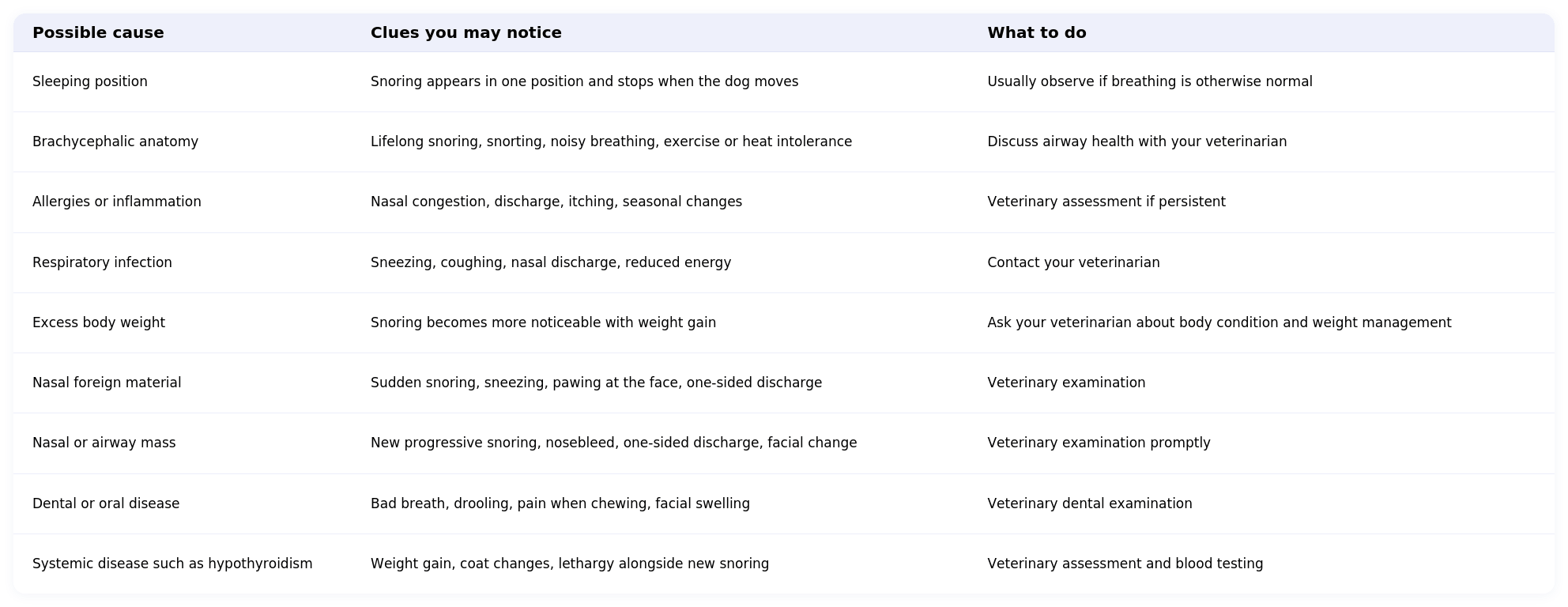
Dental or oral disease can sometimes affect nearby tissues enough to change airflow. An abscessed tooth root or oral swelling may contribute to new breathing noise. Systemic disease can matter too. Hypothyroidism may contribute to tissue changes that worsen snoring, particularly when weight gain, coat changes, or lethargy appear at the same time.
VCA identifies sleeping position, brachycephalic anatomy, allergies, respiratory infection, obesity, nasal foreign material, and airway masses among causes or contributors to snoring in dogs.
Sleeping Position
Position is one of the simpler explanations. A dog that normally sleeps curled up may suddenly snore while lying on their back or with their neck pressed against bedding. VCA notes that positional snoring is generally less concerning when it stops after the dog changes position and breathing remains quiet and effortless while awake. Snoring that continues regardless of position, becomes progressively louder, or appears with daytime breathing noise is a different pattern and deserves veterinary assessment.
A useful observation is whether the sound changes when the dog rolls onto their side. If it does, and daytime breathing remains silent and effortless, position becomes a more plausible explanation.
Flat-faced Anatomy and BOAS
French Bulldogs, English Bulldogs, Pugs, Boston Terriers, Pekingese, Shih Tzus, Boxers, and other short-muzzled breeds have less space within the upper airway. Cornell describes several abnormalities associated with brachycephalic obstructive airway syndrome, including narrowed nostrils, an elongated soft palate, everted laryngeal tissue, and a narrow trachea. Any combination can restrict airflow.
Snoring is therefore common in these dogs, but “common” should not be confused with “healthy.”
Cornell lists noisy breathing, exercise intolerance, gagging during eating or drinking, labored breathing, open-mouth breathing, blue gums, and collapse among BOAS signs. Dogs with a respiratory crisis need immediate veterinary treatment.
A 2024 Journal of Veterinary Internal Medicine study associated brachycephaly, greater BOAS severity, and excess body weight with higher risk of sleep-disordered breathing in dogs.
Allergies, Infection, and Congestion
Swelling does not have to be dramatic to make a sleeping dog noisier. Allergies can inflame tissues lining the respiratory passages. Infections can add both swelling and nasal discharge, further narrowing the space through which air moves.
Look at the rest of the picture. New snoring alongside sneezing, coughing, nasal discharge, or a noticeable change in energy is different from a dog that has made the same soft snore every night for years.
Excess Body Weight
Extra tissue around the airway can make breathing during sleep more difficult. VCA identifies obesity as a contributor to snoring, and the 2024 sleep-disordered breathing study found excess weight was independently associated with greater obstructive breathing risk.
Do not respond by sharply restricting food without a plan. Ask your veterinarian to assess body condition and set an appropriate calorie target if weight is contributing to airway problems.
Foreign Objects and Nasal Masses
A dog that was quiet yesterday and suddenly begins snorting, sneezing, pawing at the nose, or snoring loudly may have material lodged in a nasal passage. Grass awns and other plant material are examples. VCA notes that a nasal foreign object can partially obstruct airflow and produce snoring.
Masses can do the same. Benign growths and cancers can narrow the nasal passages or upper airway. Nosebleeds, discharge from one nostril, facial swelling or deformity, and steadily worsening breathing noise make veterinary examination more pressing.
When Is Dog Snoring a Concern?
A familiar, position-dependent snore in a dog that otherwise breathes normally is very different from a new respiratory sound.
VCA recommends making a veterinary appointment when new snoring becomes something you notice regularly. Call sooner when it comes with another airway sign.
Signs That Need Veterinary Assessment
Contact your veterinarian if snoring is accompanied by:
- new snorting or noisy breathing while awake
- coughing or repeated gagging
- sneezing that persists
- discharge or bleeding from the nose
- reduced tolerance for normal exercise
- difficulty coping with heat
- open-mouth breathing at rest
- a progressive increase in respiratory noise
- changes in appetite, energy, or normal behavior
A dog that used to sleep silently but now snores every night and has begun stopping halfway through the usual walk is giving you two connected pieces of information. Mention both when you call.
Changes outside sleep can also matter. Hoomanely's guide to behavioral changes as early signs of illness explains why a new physical sign is easier to interpret when appetite, activity, and routine are considered at the same time.
Emergency Breathing Signs
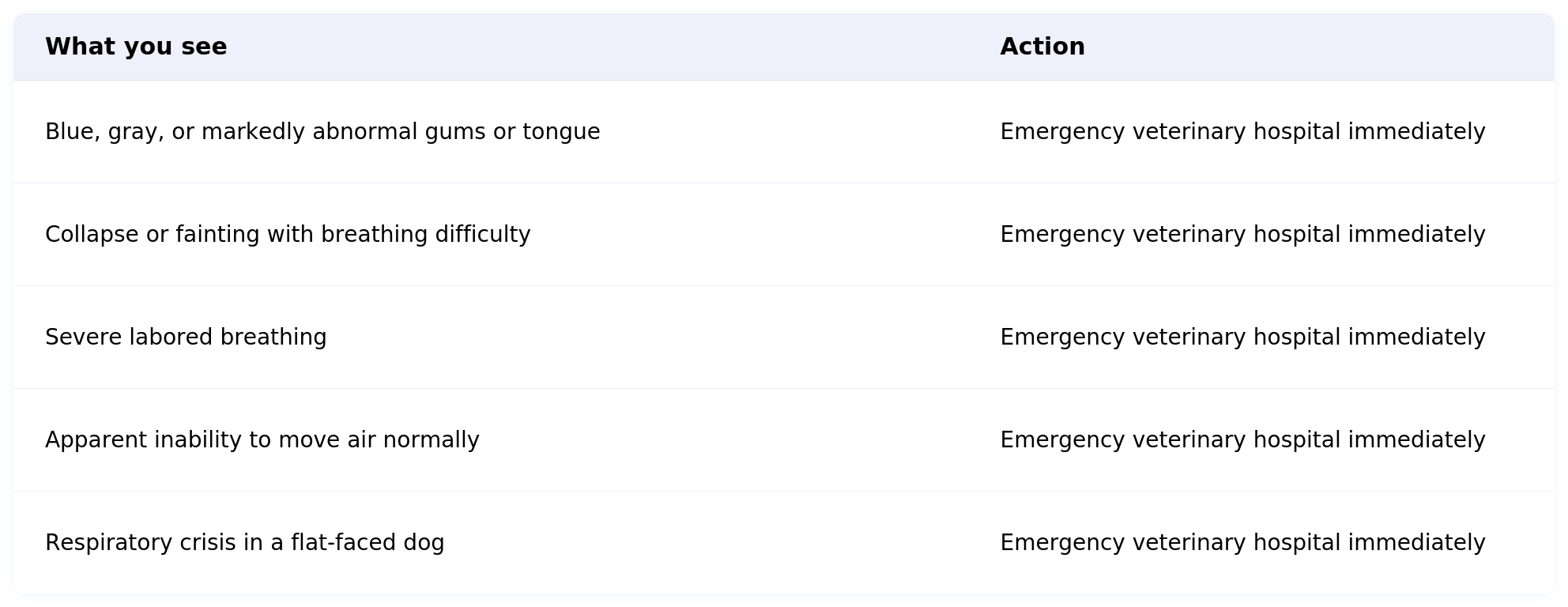
Cornell specifically identifies blue gums, labored breathing, and collapse among severe BOAS signs and advises immediate transport during a respiratory crisis. Merck likewise treats significant upper-airway obstruction as potentially life-threatening.
Do not spend time taking more videos, changing sleep position repeatedly, or trying home remedies when a dog is struggling to breathe.
How to Check Your Dog’s Breathing at Home
Tufts University’s HeartSMART guidance recommends measuring respiratory rate while a dog is sound asleep and uses fewer than 30 breaths per minute as a normal sleeping respiratory rate. One complete rise and fall of the chest counts as one breath.
This is a reference value, not a diagnosis. A sustained increase from the dog’s usual sleeping rate, especially with visible breathing effort, coughing, weakness, or another respiratory sign, should be discussed with a veterinarian.
Heavy breathing in dogs while resting, especially with visible abdominal effort, flared nostrils, or open-mouth breathing, matters more than any nighttime sound. Heavy breathing in dogs while lying down awake is a stronger warning sign than an isolated snore.
If your dog is otherwise stable, record the sleeping rate under similar conditions over several nights. A consistent change from the dog’s usual pattern can be useful information to share with your veterinarian.
Snoring vs. Sleep-disordered Breathing
Snoring does not automatically mean a dog has sleep apnea.
Sleep-disordered breathing describes abnormal breathing during sleep. Obstructive events occur when airflow is reduced because the upper airway narrows or closes. Snoring can occur alongside those events, but the sound alone cannot tell you whether clinically important obstruction is happening.
A 2023 Journal of Veterinary Internal Medicine study found more snoring and obstructive sleep-disordered breathing in brachycephalic dogs than in dogs with longer skull shapes. A 2024 follow-up study identified brachycephaly, greater BOAS severity, and excess weight as risk factors for obstructive sleep-disordered breathing.
Snoring is not the only form of heavy breathing in dogs while sleeping.
Watch for:
- apparent pauses in breathing
- gasping or choking-type sounds during sleep
- repeated waking or unusually restless sleep
- sleeping in unusual upright or airway-opening positions
- marked daytime fatigue alongside nighttime breathing noise
A phone video of an episode can be useful to your veterinarian. Record what actually happens rather than trying to reproduce the sound during an appointment.
How Veterinarians Investigate Persistent Snoring
The workup starts with history and physical examination.
Your veterinarian will want to know whether the snoring has always been present or began recently, whether it occurs only during sleep, which positions make it worse, and whether there is coughing, sneezing, nasal discharge, exercise intolerance, gagging, or breathing difficulty while awake.
The next step depends on where the problem appears to be.
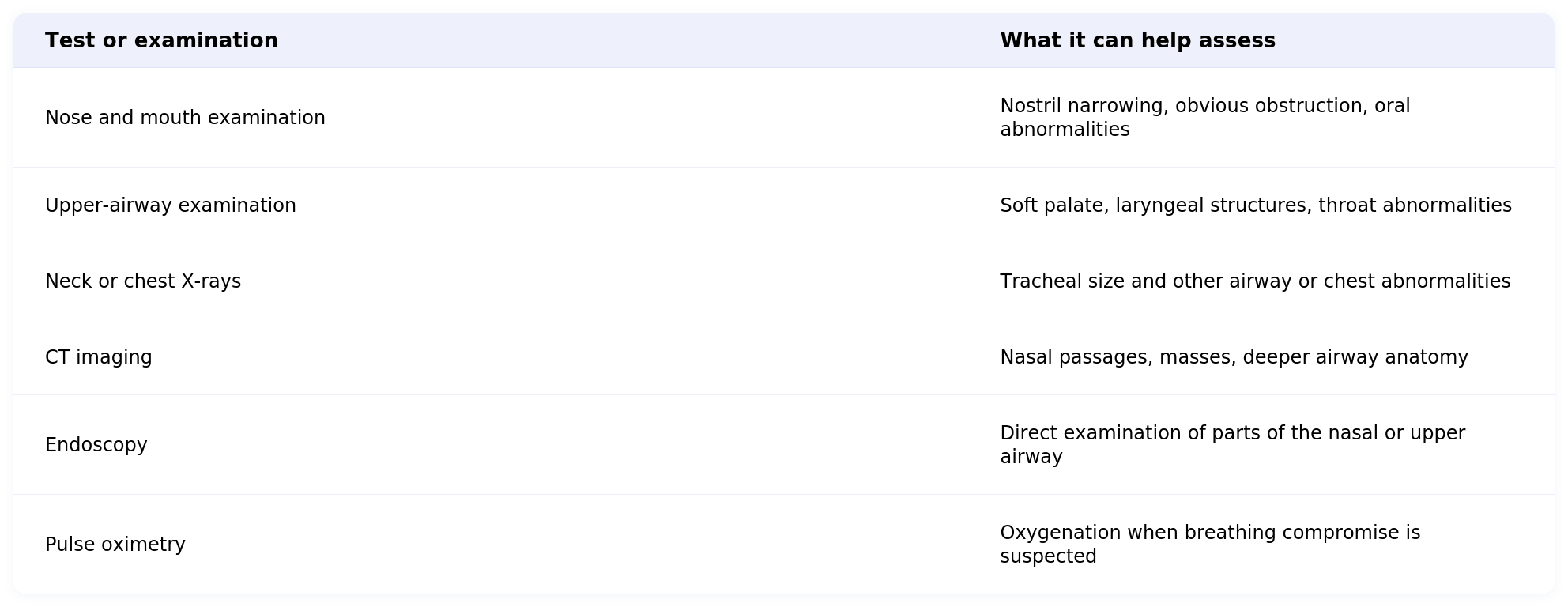
Cornell notes that BOAS assessment may include examination of the nostrils, airway examination under anesthesia, neck and chest X-rays, endoscopy, or CT depending on the suspected abnormality. Merck also notes that imaging and oxygen assessment can be useful when obstructive airway disease is suspected.
What Can Help a Dog That Snores?
Treatment follows the cause. The goal is not simply to make the bedroom quieter.
If position is responsible, changing the sleeping setup may be enough. If inflammation or infection has narrowed the airway, treating that condition may reduce the noise. A nasal foreign object or mass needs veterinary treatment rather than a home workaround.
For dogs with BOAS, Cornell recommends maintaining a healthy weight, limiting excessive panting, avoiding excessive heat and humidity, controlling activity and stress, and using a harness rather than a neck collar. More severe anatomical obstruction may need surgical correction.
Do not give antihistamines, decongestants, sedatives, or human sleep products simply to quiet snoring unless your veterinarian specifically tells you to. Suppressing a symptom without understanding the airway can delay diagnosis of the actual problem.
If the snoring is new, a short video plus a few specific observations is more useful than saying, “He has sounded strange lately.” Note whether the noise happens only asleep, whether it changes with position, and whether breathing, activity, appetite, or drinking has changed during the day.
What an Eating and Drinking Baseline Can Add
Snoring itself is an airway sound. A feeding record cannot diagnose why it is happening.
Hoomanely EverBowl™ learns a dog's normal eating and drinking patterns and recognizes when those patterns shift from the individual baseline. If new nighttime breathing noise appears at the same time as reduced appetite, hesitation around meals, or a change in drinking, that longitudinal context can give the veterinarian a clearer timeline.
EverBowl does not listen for snoring, diagnose sleep apnea or BOAS, identify an airway obstruction, or determine whether a respiratory emergency is occurring. The value is the record: showing when eating or drinking patterns changed alongside the respiratory signs you observed.
If your dog is struggling to breathe, has blue gums, or collapses, act on those signs immediately. Do not wait for additional pattern data.
Conclusion
Some dogs snore because of sleep position or their natural airway anatomy. New, worsening, or persistent snoring needs more attention when it comes with coughing, gagging, nasal discharge, exercise intolerance, noisy breathing while awake, or another change from the dog's usual pattern.
Flat-faced dogs deserve particular attention because snoring can be part of BOAS rather than simply a breed quirk. Breathing difficulty, blue or gray gums, collapse, or an apparent respiratory crisis requires emergency veterinary care. For non-emergency changes, record a short video and note when the snoring began, when it happens, and what else has changed before speaking with your veterinarian.
FAQs
1.Is It Normal for a Dog to Snore Every Night?
It can be normal for some dogs, especially when the sound has been present for years and breathing is otherwise easy. Flat-faced dogs commonly snore because of upper-airway anatomy, but persistent snoring in these breeds can also accompany BOAS. Snoring that becomes louder or appears with exercise intolerance, gagging, open-mouth breathing, or noisy daytime breathing deserves veterinary assessment.
2.Is It Normal for a Puppy to Breathe Fast and Make Noise While Dreaming?
Usually yes. Puppy heavy breathing while sleeping is common during REM sleep, when faster breathing, twitching, and small sounds can accompany dreaming and settle as the sleep phase changes. It deserves a veterinary call when fast or noisy breathing continues after the puppy wakes, or occurs with poor appetite, coughing, weakness, or reduced energy.
3.Why Has My Dog Suddenly Started Snoring?
Sudden snoring can occur with congestion, airway inflammation, infection, a change in sleeping position, a nasal foreign object, or another obstruction. VCA recommends a veterinary appointment when a new snore becomes regularly noticeable, particularly when sneezing, nasal discharge, coughing, or other respiratory signs are also present.
4.Does Snoring Mean My Dog Has Sleep Apnea?
No. Snoring can occur without sleep apnea. Sleep-disordered breathing involves abnormal airflow during sleep and may include obstructive breathing events, gasping, restless sleep, or apparent breathing pauses. Brachycephaly and excess weight are recognized risk factors, but veterinary assessment is needed to determine what the snoring represents.
5.Can Being Overweight Make a Dog Snore?
Yes. Extra tissue around the upper airway can reduce the available space for airflow. VCA lists obesity as a cause of snoring, and a 2024 veterinary study identified excess weight as a risk factor for sleep-disordered breathing in dogs. Weight loss should be planned with your veterinary team rather than through an arbitrary food reduction.
6.Should I Wake My Dog If They Are Snoring Loudly?
Loudness alone does not determine whether snoring is dangerous. Check whether breathing remains regular and effortless and whether gum color is normal. If your dog appears unable to breathe normally, has blue or gray gums, becomes unresponsive, or collapses, seek emergency veterinary care rather than repeatedly waking or repositioning them.
7.Why Does My Flat-Faced Dog Snore So Much?
Flat-faced dogs have shortened skull anatomy that can leave less room for normal upper-airway tissues. Narrow nostrils, an elongated soft palate, everted laryngeal tissue, and a narrow trachea are among the abnormalities associated with BOAS. Snoring is common, but difficulty exercising, gagging, labored breathing, open-mouth breathing at rest, blue gums, or collapse should not be dismissed as normal for the breed.